Monday, December 7, 2009

The 350.org Sign

I received a text message on previous Friday afternoon from Ai asking if we should do the 350.org sign at the airport fence. Me being blur as usual, I answered her, "What 350.org?" and Ai told me to check my email. After reading Ai's email and I started to google what is 350.org all about. Ooohhh.... ahhhh... how come I didn't know about this earlier?

So, the mission was on that night itself. Ai strongly wanted that night itself because the following day will be the last day of Langkawi International Maritime and Aerospace Exhibition (LIMA) and there will be more people passing by the area. We gathered recyclable materials like aluminium cans and plastic bottles. Thank you M for that! We now know the purpose of these "usable rubbish" you have kept for so long.


Ai, M, a long lost friend from KL and myself headed to the airport where the Laksa Power stall is. That area was so filthy with rubbish like plastic cups, styrofoams "white coffin", food wrappers and etc thrown all over the stalls area. Extra stalls were set up for public spectators that wanted to have free viewing of the aerospace display.

Our initial plan was to stuff these recyclable items into the fence holes to create a 350.ORG sign. Ai thought that the holes for all similar fences would have the standard diameter or size. Not quite right. The holes at the airport fence were so small that an aluminium can cannot even be pushed through. Plan A aborted and we had to use the fence opposite of the airport. The holes were bigger.

Our work began in the dark. There was quite a heavy flow of traffic passing by and luckily no one stop to check on us. Phew!

Ladies at work...
In about half an hour, we did it! 

Ta-daa...

On the next morning, M cycled to the same spot to check and take a picture in the daylight. Half of the "0" was blown by the wind.


Later that afternoon, all rubbish were cleared and the 350.org sign as well. We wonder how many people would notice that. Well, I ain't an absolute "green person" and I surely had fun doing it. We were not guilty about adding on more rubbish to the site. The collector must be happy to have extra cleaned aluminium cans and plastic bottles to be recycled.

To learn more about the current and a very important conference on Planet Earth, read Copenhagen Climate Summit and 350.org.

... Read full post ...

Tuesday, November 24, 2009

Monyet Cafeteria

When tourists in Langkawi want to see monkeys, where would be the best convenient spot to take them to? Telaga Harbour, of course.

A friend of mine  informed me  of the increased population of Long Tailed Macaques (Macaca fascicularis)  on the road next to Telaga Harbour and here's the reason why.


There is a "cafeteria" setup for these macaques! This "cafeteria" may have been around for a few months by now.

Easy life for these macaques to have their daily feed. This encourages macaques to frequent this area often and the young ones were seen playing in the middle of the road. A potential hazard for road kill or even a hazard to the road users too.

I need not elaborate further on the consequences of feeding these macaques. It is a common sense and only sensible homosapiens would know the answers.

Here is more reading on morons on Planet of the Monyets.

... Read full post ...

Could this be Langkawi's First Sighting??

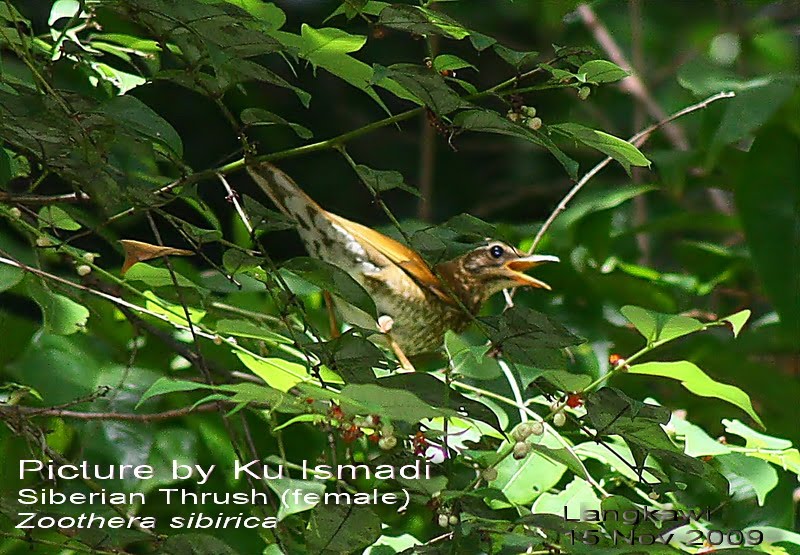
Indera Suhardy yelled, "What is this bird? I have not seen it before??" All of us directed our binoculars to the movement among the foliage of the tree with fruits that looked like some berries.

Ku Ismadi and I joined Indera to have a glimpse of Mugimaki Flycatcher (Ficedula mugimaki) on the afternoon of 15th November 09. We got off the cars on the slope with the edge of secondary forests and the air was cooling with some breeze. Just within minutes we were lucky to have this flycatcher perched on a branch.
After Indera's exciting scream, we were looking at this unknown bird. The features I saw were the white vent with dark-scaled undertail-coverts, a very distinct white supercillium, yellow tarsus and a dark greyish upper part. Then another one came along except that it had a brownish upper part. We quickly checked the guide book and got confused. Ismadi had to leave us for work, Indera was thinking of a woodpecker family and I thought it was a dove family. Still clueless, we called for another sifu, Jimmy.

Two sifus, Indera and Jimmy cracking their heads trying to figure out the bird id.
The rain came and it was time to leave the area and the mystery unsolved. Besides the unknown bird and Mugimaki Flycatcher, we also recorded: Asian Brown Flycatcher (Muscicapa dauurica); Blue and White Flycatcher first-winter male (Cyanoptila cyanomelana); Asian Fairy Bluebird (Irena puella).


Later that night, I checked through my notes and opened up my guidebook. After a few pages of flipping thru, I was staring at the drawing which fits our observation. I immediately informed Indera and Ismadi that the birds were at least 90% Siberian Thrush (Zoothera sibirica) species.
Indera returned to the same spot on the following day and he excitedly confirmed that the birds were Siberian Thrush. Yeehoo!

Ismadi also returned to the same spot on the 17th Nov to obtain the evidence.


Both of them told me that this species is not in Langkawi's list yet. So, does that mean that this is our first sighting? I have submitted the sighting to Bird i*Witness Malaysia and the Malaysia Nature Society Birds Committee. Let's wait what they have to say then.

Siberian Thrush is omnivorous feeding on insects, worms and berries. The wonderful fact is that this species breeds in the coniferous forest type in Siberia. This thrush would migrate a long journey all the way to Southeastern Asia during winter. And guess what? It is the birds migatory season now!! Go get your bins out!

Thanks Indera for first spotting that birdie and Thanks to Ismadi for the pictures. I got my lifers :)
References:
1. A Field Guide to the Birds of South East Asia by Craig Robson
2. Wikipedia

... Read full post ...

Wednesday, November 18, 2009

There It Goes Again!

This is my second time catching it red-handed in stealing fish from the fish farm. The owner is not going to be happy. But we were very happy to catch the act of "this drama" which happened in Kilim Mangroves, Langkawi two days ago.

This water dog is known as the Smooth Otter (Lutrogale perspicillata) was spotted snooping on the fish farm.

It checked out the first compartment but no luck. Then it noticed that we were watching. We sensed that it was deciding to flee or try its luck. Also I felt that it had identified our boat was with a bunch of tourists so it decided to continue its act.

It walked over to the next compartment hoping for a luck of meal.
                                     
It walked in a cool manner in search of its next meal. And it found one! It  dived into the compartment, came out with a fish in its mouth and took a dip into the water. All of this action was in less than 30 seconds and left me no time to catch the moment of it capturing the fish. What a cool smooth act! Yes, this smooth otter was faster than my finger tip on the shutter. Bah! I forgot to switch to the continous shooting mode.
Having a face like a dog, smooth otters are considered as one of our mangroves top predators. Not just in the mangroves, these otters were spotted along the coastline of the island. They mainly feed on fishes and are excellent hunters. They are usually shy and can be seen travelling in pairs. In these two years, I noticed a decline of smooth otters population in Tanjung Rhu mangroves. I wonder why?
Have they moved to Kilim in search of food? Being shy creatures, why did they resort to taking fish from the farm instead of hunting? Where do they nest? Have their nesting area been disturbed? Have there been any population count of these otters in Langkawi?

... Read full post ...

Thursday, November 12, 2009

A marine creature close to extinction in the waters of Tanjung Rhu, Langkawi

This is awesome! This was found on the beach of Tanjung Rhu yesterday! I got off the boat and spotted  this starfish in the water.

So, I picked it up to have a closer look.   


It had six long legs and two shorter ones.

Check out the size.

Below picture is showing the underside of the starfish. Notice the tube feet.
                                     
Here's a closer look at the tube feet. Check out the pointed tip. It was a poking feeling when I was holding it.                              
                                     
Not knowing much about starfish or sea stars, I did some search via the world wide web and found that it is very likely to be a Eight-armed Sea Star (Luidia maculata), a family of Luidiidae. This Eight-armed Sea star that I picked up with two shorter legs would very likely be a juvenile or sub-adult.

According to the locals, Tanjung Rhu once had a abundance of corals and sea stars many years ago. Those were the days before the five-star resorts were developed on this beach. A large amount of sand were dredged from the sea and thus reducing the population of these precious sea creatures eventually.

What did I do with this creature in the end? I got back to the boat and instructed my skipper to take me to the middle of the ocean. I said bye and dropped it there. I hope I did the right thing.
Read more about this from: Wikipedia, Eight-armed sea star of Singapore

... Read full post ...

Friday, October 30, 2009

Horror!! Aliens Landed On Payar Island

M and I had nothing much to do on that day and decided to take a ferry down to Payar Island which is supposedly reputed to be the best coral reefs area in the West Peninsula Malaysia. Payar Island is the nearest getaway for cityfolks of Penang, Perak, Perlis and Kedah for snorkelling and diving.

Before we even got off the ferry, we were already put off by the operator's announcement on the timing for the sharks feeding. Instead of watching some sharks scavenging on the scrap food leftover by the tourists' lunch boxes, we decided to take a stroll.

We walked towards the other end of the boardwalk and we were shocked to see a few "alien aircrafts" have landed on the slope of the Payar Island hill.
Semi UFO or Half-golf ball looking chalet. Weird design when it is not even a golf resort.

Thru the "western and eastern wind", we came to know that the whole thing was supposed to be a resort built by by the former Kedah's head of government, Syed Razak bin Syed Zain Barakhbah. The resort was built and it was left abandoned before the operation started. The reasons could be due to strong opposition from other parties that were concerned about the environmental damage. Or possibly Syed Razak had a downfall.

So now that these existing structures are already in placed and what next? Well, since the state is under the new government, YB. Encik Mohammad Radzhi Bin Salleh, the Exco Tourism of Kedah state had approved the operation of 12-room resort. And the winner of the project taker is Raymond Foo of D'Coconut Resort. This information is taken from Langkawi's Marine Park Gets a Resort. You may also read from the comments that Raymond pledged to run the resort in a "green" way. How "green" can be achieved in this highly sensitive area? I'm afraid I'm a non-believer in a green resort. There would be some amount of impact and the only question is how much. What more can the impact do to a highly sensitive area like Payar Island.

Payar Island does not have vast flat areas. Behind the small beaches is the range of hill. That's why the stilted chalets were built on the slopes of the hill.


This is a high potential for sediment run-off during heavy rain and thus increasing sedimentation load on the corals. The increasing sedimentation load on the corals will lead to blocking off sunlight thus reducing the growth of corals.


Human waste will go down into the sewage tank below and eventually cause seepage into the underground. There is no sign of sewage or waste treatment area built. Looking at the geographical landscape of Payar Island, it is almost impossible to build one when there is a lack of flat areas. What if the tank is filled? Nutrients run-off from human activities will encourage algae growth and eventually competes with the corals for sunlight and living space. When corals die, it will be a domino affect, the marine fishes will eventually die.

Here are more hideous looking chalets:

We wonder if any recent an EIA was done for this project? Will our government care enough to do a thorough survey or health check on the corals before allowing the operation of this resort?

For further reports highlighted to the media: Letter to MalaysiaKini, EcoMalaysia.org

Sadly, the jewel of Langkawi is willing to be sacrificed for the sake of making quick monetary return instead of conserving what is left on our west coast and not realising that the rice bowl of the islanders will eventually be broken.

Eventhough it was supposedly a low season on that day, look at the number of people on that beach. I wonder what will be like on high season... eeewwwww...

Other references:
1. Yusri Yusuf's Thesis on Payar Marine Park
2. WWF's Lim lee ching "Lim, L.C., 1998. Carrying Capacity Assessment of Pulau Payar Marine Park, Malaysia - Bay of Bengal Programme.
... Read full post ...
Related Posts Plugin for WordPress, Blogger...