Showing posts with label Tanjung Rhu Langkawi. Show all posts

Saturday, September 8, 2012

Where's My "Real Rain"?

We are now in the month of September. And yes, it is still the raining season. Supposedly. And yet, where is the real rain??? 

What is the "real rain" to me? A "real rain" in Langkawi to me means a minimum of three days of non-stop rain. It will start with a heavy downpour and then slow down to drizzle for awhile and then heavy downpour again. This cycle will go on till night and then the next day and the next day... and another day till the rain stops completely. With such rainfall for such duration, there will be flash floods on some areas. This is normal for the island every year.

Looking back a year ago, especially towards the end of August 2011, Langkawi has five days of continuous rain. Yes, it was non-stop! The glorious rain also turned Temurun into glorious waterfall. I was there last year during the five days rain and check out these pictures below.


A year later and twelve days after 25th August 2011, I was at Temurun Waterfall. Click below for more...

Such mild rain was not enough to create a full blast for this waterfall

August this year was hot and humid. There was a big rain with strong wind on August 24th 2012 and it lasted for one day only. And then the weather turned hot again the next day until August 27th afternoon when the heavy rain came. But it was only for that evening. The next day, the rain came in the morning until late afternoon. And then hot hot hot!! I recorded a temperature of 34deg Celsius on September 3rd 2012.

While out at sea on the boat, a sudden change from a calm cloudy morning to rainy afternoon on September 5th and 6th 2012!! I took the opportunity to capture the moments of stunning storm clouds.

It was kind of non-stop and it was a bit generous by giving short breaks in between. Two days of rain... and only two days!! Two days of mild rain and the rain clouds disappeared rapidly. And so it was back to normal clear blue skies with some white clouds today... boring..

Here I am pondering if the global climate change has anything to do such weather patterns. I am anticipating for the "real rain" for a normal rainy season. 

... Read full post ...

Saturday, December 31, 2011

Tanjung Rhu Beach Access Is Now Open

The gate was opened since four days ago and there will still be security guards on that spot. The guard on duty on that day was welcoming. Just tell them your intention of entering the area and then smile...
That day was on a spring tide and the lowest tide for the morning was 0.02m. A perfect tide condition for us to walk on the sand bar to the island opposite Tanjung Rhu Resort.

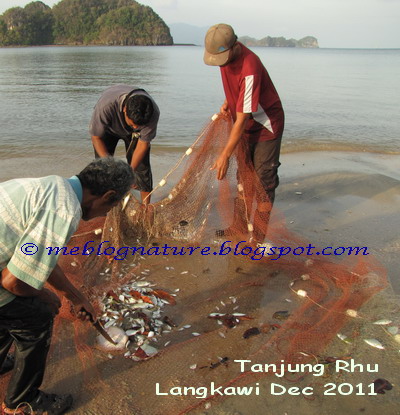
I love this intertidal walk on Tanjung Rhu simply because each time when I am there, I see different things. On that morning, we were able to witness some local fishermen dragging out the net from the sand bar displaying their harvest.

The man on the left with a knife was stabbing on a stingray. He then dragged the ray aside before slashing its tail off.

A species of stingray family
A species of Leatherjack (family Monacanthidae)
A couple of squid and a ray with chopped off tail
My guests felt sorry for the tiny fishes and started to pick them up to chuck them back into the water
There were other variety of fishes that I couldn't recognise and I have not seen them before. Most of the species of fishes caught were at juvenile size and yet they were taken by the locals. I am sure you will agree with me should we talk about sustainable fishing.
As you leave Tanjung Rhu beach and exit through the barricade, remember to wave your hand to the guard on duty as a gesture of thanks. You will make them feel special. Having to stand there on duty can be boring.


... Read full post ...

Saturday, December 24, 2011

Tanjung Rhu Beach Access Is Now Closed

When the construction of this guard house started sometime this month, I was wondering of its purpose there. It was setup by Tanjung Rhu Resort at the exit junction of the resort. But, why was it built at the exit junction?
Do you notice a group of people on motorbikes? They are the boat operators waiting for the tourists that have made the bookings for boat rides. They have to wait at the gate so that they can bring the tourists in.

The red sign on the Casuarina tree stated very clearly, "This is a private land and access to the beach is granted conditionally and can be revoked at any time". To everyone's surprise especially the local community, the beach access was revoked today and without much notice.

Why?


The gate leading to the one of the most beautiful beaches of Langkawi is now temporary closed to public from December 24th until the issues are resolved. 

I was informed by one of the local boatman that some of the local communities here has encroached into the private property of Tanjung Rhu resort. About a few months ago, a huge number of Casuarina trees were brought down and a certain amount of the area was cleared by these local communities. This area was likely cleared to extend the boat operator counters and to improvise the jetty condition.

Unfortunately, these trees were planted by Tanjung Rhu resort and they were cut by these locals without prior permission from the resort. As such, it is the pay back time for these local communities for their foolish act. Personally, I wasn't pleased at all with the number of trees been cut. It has made that spot exposed to heat and an eye sore to the visitors.

Tanjung Rhu Resort was definitely not pleased with the acts of these local communities and this is the way to show the locals that it is enough.

There was another source which I heard that the land apparently was taken by the Government and the locals thought they have the rights to clear the area. All this while, the jetty for these boat operators are sitting on Tanjung Rhu Resort property. There is a land dispute going on here.

And of course, these locals are not happy at all. Those affected would be the boat operators stationed at Tanjung Rhu jetty, shop owners, stall and restaurant owners. The beach today was awfully quiet.

Access to Tanjung Rhu area is still possible provided bookings were made to authorised boat operators at the jetty. Permission is required at the guard house to enter.

Wow... what a timing to close the access road to this beautiful beach especially when it is the peak season for all on the island.

... Read full post ...

Wednesday, February 10, 2010

My Week of Snake Skin

Another discarded snake skin found this morning in Tanjung Rhu Mangroves of Langkawi. This must be my week of discarded snake skins.

Our boat was closing into the foliage of the mangroves and our skipper slowed down and started to reverse. Then suddenly, one of my guests shouted, "A snake!". My eyes were looking everywhere on the lowest branches of the trees. Feeling a bit embarrassed to ask, my mind was asking "Where? Where?". I looked at my skipper for a clue and then he said in Malay, "Kulit ular" (snake skin). I saw the discarded skin dangling on the leaves. However, my guests were still focusing on a different spot. And then shortly, I saw that snake hanging on the limbs.  Even my skipper who has good eyes didn't even spot it first... hahahhaha...

Everyone took their turn to snap pictures of the snake with the new skin. Because of that and all the excitement on the boat, I literally forgot to take a picture of the discarded skin. Bah!! That snake had a very beautiful shining skin and it looked "brand new" indeed. Unfortunately the discarded skin was incomplete. The head has gone.  

Someone asked me the species of that snake. "It is a Mangrove Pit viper!" Upon hearing that word "viper", the boat tilted to one side because most of them moved across away from that snake. 

The picture above was taken in November 2009. Mangrove Pit Vipers (Trimeresurus purpureomaculatus) are commonly found in mangroves of Langkawi and spotting one can be a challenge. They can be spotted hanging on the limbs of the trees between a meter to 3 meters above the water.  

One of my encounter with a mangrove pit viper was when I was pointing my finger to the mudflat while talking and looking at my group. As I looked down to where I was pointing, a juvenile pit viper was less than a meter away and ready to strike. Phew!

... Read full post ...

Sunday, January 17, 2010

Ugly Side of Langkawi Mangrove Tours Part II - How to Make Monkeys Swim


I mentioned in the first part of this topic, mangrove excursions here are so popular that operators would do anything to earn more even to the extend of exploiting the wildlife.
Long-Tailed Macaques (Macaca fascicularis) are common predators in our mangroves. They are sociable mammals, comical and at times can be quite aggressive. These monkeys move in groups as they forage in the mangroves for young seedlings, mangroves vegetation, crabs and snails. In the mangroves, hunting time for such animals very often depends on the tide condition. Macaques are mostly active searching for food during low tides where they are able to reach further to the mudflats and hunt for their favourite crustaceans.

Most people love monkeys particularly the tourists. It is very common that they would ask to see these cute primates prior to hopping onto such nature excursions.

Macaques usually move about in the mangroves in search of food. There are days when they are around and there are days that they are not.  Therefore, to please these tourists, the unethical operators/guides have resorted to unhealthy practice of feeding the macaques to ensure that they are always around in the same area.


Here is the exciting part. MACAQUES CAN SWIM! “What? Are you sure? How?” a tourist asked in disbelief.
The unethical operators/guides would demonstrate how you can make macaques swim. Chuck the food in the water and see what they will do. 
In addition, here is their "bullying" way to see the macaques swim for a distance. Invite one or two on your boat by luring them with food.
Then the boat will move away from the shore for a distance. Then you can force it to jump into the water like a pirate pushing the victim off the ship. 
Man Overboard! or "Macaque Overboard"!
You can be one of the merciless spectators enjoying the act of the macaque dog paddling to the shore. And while you are at it, you might as well video the whole scene too!
What a cunning way to earn more tips from the tourists! The monkeys get a dunking to get some food, the tourists are happy and the unethical operators or guides are surely happy and spurred to keep up this ruthless practice to pocket extra ringgits.


... Read full post ...

Sunday, January 10, 2010

An Ambush Predator In the Mangroves of Langkawi

This aggressive mangrove crab is a fierce predator that would snap its claws at anything it thinks it can eat including your feet! (White, 1847)

Forceps Crab (Epixanthus dentatus) picture taken from http://www.madeinnys.com/mangrove/e_dentatus.htm 

According to Dahdouh-Guebas et al., 1999; this Forceps Crab Epixanthus dentatus (White 1847) is an omnivorous crab but preys mostly on crabs and as well as climbing on mangroves roots (Cannicci et al., 1998). 
A forceps crab can grow only up to the carapace size width of 8cm. It can be identified with scattered orange granules on its carapace that normally hides under driftwood, rocks or debris. Like a male fiddler crab, this forceps crab E.dentatus has an abnormal claw. Unlike the male fiddler crab, the forceps crab E.dentatus has one thin claw and the other is a thick crushing claw. See above picture.
The stout right claw has a special tooth used for opening gastropods or crustaceans. While the other thin claw is like a forceps tool (or like tiny chopsticks) extracting the flesh of its prey. Wow! No wonder E.dentatus is called Forceps Crab.

I can't recall having to encounter a live E.dentatus yet but I was fortunate to find its exoskeleton or carapace. This carapace was found on the mudflat at low tide while I was kayaking in the narrow tributaries of Tanjung Rhu mangroves. From the shape of the carapace,  I believe that this E.dentatus must have gone through the molting process. Aha, it had became a soft-shell crab. I hope to see a live one with its claws ready to strike.


Classification: Biota > Animalia (Kingdom) > Arthropoda (Phylum) > Crustacea (Subphylum) > Malacostraca (Class) > Eumalacostraca (Subclass) > Eucarida (Superorder) > Decapoda (Order) > Pleocyemata (Suborder) > Brachyura (Infraorder) > Eubrachyura (Section) > Heterotremata (Subsection) > Eriphioidea (Superfamily) > Oziidae (Family) > Epixanthus (Genus)


This latest classification was taken from : World Register of Marine Species (WoRMS) 


References: 
2.  A Guide to the Mangroves of Singapore II; published by Singapore Science Center.


Acknowledgement:
1. Thank you to A Field Guide to Kenyan Mangroves website for the picture (hope you don't mind)

... Read full post ...

Tuesday, December 29, 2009

Ugly Side of Langkawi Mangrove Tours Part I - Mat Rempits


Tourists visiting Langkawi were told that their visit will not be complete without having experienced the island's magical mangroves. Very true. 
When a tourist arrives at Langkawi airport or jetty, the tourist will be handed with flyers after flyers for things to do on the island. Pick up any one of those flyers and these words will be staring at your face. "Mangroves Cruise"; "Mangroves Safari";"River Cruise";"Fish Farm";"Bat Cave";"Crocodile Cave" and the worst "Eagle Feeding". With such heavy promotions and raving about the mangroves, tourists would definitely be  looking forward to partake in it. Tourists can pick a boat from the Kilim or Tanjung Rhu jetty and will be enthralled by a two or three hour ride even without a guide onboard.
Langkawi was bestowed with the land and sea forests surrounded by prehistoric fossils and rock formations since some millions of years ago. Her mangroves were groomed well with the amazing karstic features of Setul formation that formed about 45o million years ago. Having such blessed natural heritage, Langkawi has became popular among the tourists that love to spend their holiday relaxing in the serenity of nature. The result of the high influx of tourists to the island has created many lucrative job opportunities for the locals. Over the years, many of the locals that were into fisheries and agriculture had embarked into tourism related jobs such as taxi, bus drivers, restaurant and boat operators. Then gradually, Langkawi has gained a higher status to become a UNESCO heritage site in mid 2007 and is now known as Langkawi Geopark. 
With the Geopark status, the amount of tourists coming in has doubled or if not, almost tripled. This benefits the island with such huge economic boom and yet I am witnessing the sufferings of Langkawi's flora and fauna that they have to bear daily.

Great supply of tourists resulted in mushrooming of operators particularly for the mangroves. The latest craze was the 1km traffic congestion at Kilim jetty due to tourists waiting for availability of boats to take them out. Welcome to the school holidays and festive season!

While there were lots of tourists waiting to go for the mangroves tour, boat skippers were often instructed to cover a route with various stopovers very quickly and to return to jetty for the next tourists pickup. As such, these boats will speed like F1 drivers in the mangroves so they can make as many trips as they can for a day. More trips=more $$$.
No doubt that mangroves are able to adapt in the soft unstable soil. However, constant slamming of waves created by the speeding boats will accelerate the action of mud to be washed off from the banks causing sediments run-off. The consequences will be erosion that had caused some of the trees to collapse. Sediments run-off can pose hazard to the health of the coral reefs that reside along the coastal areas. Mud carried out to the sea by the current will eventually be settled onto the reefs, shading the reefs from sunlight and eventually killing them. 


Speeding boats not only pose hazards to the mangroves forest but also to other users of the mangroves such as the slower boats and kayaks. There were incidents whereby speeding boats turning into the sharp corners had collided with other boats. Luckily there were no mishaps.
There was another  incident whereby a boat was almost tipped over by big waves caused by an overloaded twin-engine boat that was speeding like Michael Schumacher. Because these operators are now so used to speeding in the mangroves, this habit had been formed and  is hard to die. They even speed during the low tourists season.
This is what I find difficult for me to understand about locals here. Tourists make their way to Langkawi because of what the island can offer best. Langkawi will never be a destination for shopping even though it is a duty free island because people come here for nature.  If these operators are allowed to continuously behave like "Mat Rempit" in the mangroves, all I can say is that these locals are breaking their own rice bowls. Check out what Mat Rempit means.
The good news is that there are also responsible companies offering passionate nature guides that conduct nature excursions in an ethical manner. You will expect to pay more for these excursions, however, the investment you make will return you with educational and informative experiences and not just fun boat joy rides. Example of a company will be 
This is the first part of this topic of my blog. Coming next will be my viewpoints on eagle feeding, wildlife feeding and what influences tourists have over ecotourism.

... Read full post ...

Thursday, November 12, 2009

A marine creature close to extinction in the waters of Tanjung Rhu, Langkawi

This is awesome! This was found on the beach of Tanjung Rhu yesterday! I got off the boat and spotted  this starfish in the water.

So, I picked it up to have a closer look.   


It had six long legs and two shorter ones.

Check out the size.

Below picture is showing the underside of the starfish. Notice the tube feet.
                                     
Here's a closer look at the tube feet. Check out the pointed tip. It was a poking feeling when I was holding it.                              
                                     
Not knowing much about starfish or sea stars, I did some search via the world wide web and found that it is very likely to be a Eight-armed Sea Star (Luidia maculata), a family of Luidiidae. This Eight-armed Sea star that I picked up with two shorter legs would very likely be a juvenile or sub-adult.

According to the locals, Tanjung Rhu once had a abundance of corals and sea stars many years ago. Those were the days before the five-star resorts were developed on this beach. A large amount of sand were dredged from the sea and thus reducing the population of these precious sea creatures eventually.

What did I do with this creature in the end? I got back to the boat and instructed my skipper to take me to the middle of the ocean. I said bye and dropped it there. I hope I did the right thing.
Read more about this from: Wikipedia, Eight-armed sea star of Singapore

... Read full post ...

Sunday, October 4, 2009

They Created An Impact

They braved the mud, sand flies and took up the challenge of walking barefoot in the swamp. With a single mission, the aim was to plant a hundred mangrove seedlings in the polyethylene bags (poly bag). These young seedlings will be sitting in the bags for awhile until it is time to be released into the wild. At the meantime, there will be on-going TLC (tender loving care) tasks.


What that team had done was more than just planting the seeds into the bag. They created an impact to the environment. So, what does impact to the environment mean?

Most of us know the definition of impact and depends how is being used. In short, impact to the environment means having an effect to your surrounding. I like to use a ripple effect as a metaphor in relating to the impact to the environment.

Imagine droplet of water is dropped on to a calm pool or lake.
What will happen? It creates a ripple effect. Any action from a source will create changes to the surrounding or will create a reaction in others. Depending on the size of that droplet, the bigger it is the larger the ripple effect. Here is an example on how our daily life is a ripple affect.

From the day you were born, you have already made impact to the surrounding. You cried. The affect was noise pollution. Then baby diapers and all sorts of baby accessories have to be used and that will take up some space in the landfill. And so on as the human society continues to exist on planet Earth, the impact to environment continues yet this is unavoidable.

Nature has it's own way to heal itself. If the impact is minimal, the affect will reverse to its original state. If the impact is too much to cope, the effect will become irreversible. In another word, the surrounding has been destroyed from the impact of an action. Here is another example. Imagine 100 people walking into the rainforest on a trail as compared to a bulldozer on that trail. Both activities will have an impact to the environment. But which one has a bigger impact to the environment? And which one will create an irreversible affect?
So, back to our team of eco-planters that had created two impacts. They have stomped on the mudflat and may have crushed some of the microscopic creatures living on it. The impact was minimum that allowed the condition to be regenerated at a short period of time. The second impact was greater and is a positive impact. By planting more trees would mean expanding the forest and allowing more microscopic creatures to breed. The ripple affect will also include creating awareness to others.

In summary, there is no right and wrong in an impact to the environment. The ripples affect will still happen. The questions will be “How much? How big? Good or bad?” It is all up to us.

How is your ripple affect today?

... Read full post ...

Monday, July 6, 2009

The authentic Tanjung Rhu will become "Welcome to Mini-Dubai of Langkawi"

Tanjung Rhu is situated on the north-east of Langkawi Island. The area is named after pokok rhu in Malay and these are the casuarina trees (Casuarinaceae family). As your drive along the Tanjung Rhu road, you will be greeted by casuariana trees that stand beautifully providing the cooling effect. You can simply stop your car beside the road and enjoy the scenic view of the mangroves.

Scenic mangroves with karst limestone hills as the backdrop
On weekends, this place is a popular spot for locals to wade into the mud and dig for clams, "punpun" (a kind of fat worm that is used as fish bait) and fishing. Is a cool and healthy recreation activities for families.


Traditional hobby for the locals.


Some harvest from Tanjung Rhu for the locals. The picture above is the "punpun" (mangrove worms) .

Unfortunately, truly unfortunately that this 8 hectare site will soon be be converted from a "luxurious kampung lifestyle" to an exclusive RM800 million 'residential-cum-commercial centre'. I was told that the project is now currently put on hold due to tight financial budget and I hope that this person is not talking bollocks.

From the design, this whole hideous plan looks like a mini-Dubai. Great for cheap-skate tourists that will come over to Tanjung Rhu instead of the original Dubai. Can the island sustain this massive development and the increase of population? Eventhough this project is put on hold, apparently, it will be an opportunity for us to look at their EIA. I wonder if EIA has been done before such ridiculous project been approved. The sad part is that the entire land is privately owned by Tan Sri Tajuddin. He is probably be laughing at us, "Ha,ha... is my land. I can do whatever I want!". And that makes it more difficult for us to fight against this project from happening.


Tanjung Rhu is still the one of the best beaches on Langkawi with the least crowd and it's natural heritage is still pretty much intact as compared to other sites. With this development is about to happen in near future, the locals have to look elsewhere for healthy recreation and the problem is where else can we find serene, peaceful, clean beaches when the bests were taken up, such as Tanjung Rhu. The worst will be the impact to the biodiversity of Tanjung Rhu.
The highest revenue for Langkawi is from tourism (or eco-tourism so call), mostly from the foreigners. I was amazed that a 13-year old Aussie boy clarified this infor from me. As such, most people fly in to this island is to enjoy the natural heritage that the island is still offering and not the duty-free stuffs. The islanders' rice bowl contains of the rainforest, mangroves, beaches, abundance of flora and fauna, etc. Can the islanders afford the rice bowl to be broken?

I ain't a trained activist or neither a environmentalist. Guidance is needed in seeking ways to conserve this area or at least shrink the development size. I'm a anti-politician, however, just when I was beginning to appreciate politicians like Elizabeth Wong but sadly, where have our real heroes gone to? (sob, sob)

References:
This infor is taken from: http://www.langkawi-gazette.com/newsandletters/news/241-tanjungrhu

Langkawi: A Luxury Project in Tanjung Rhu Mark, 2 June 2009 / Source: New Straits Times, 2 June 2009 and websites mentioned below'Developing' Tanjung Rhu ?A memorandum of understanding has been signed between ‘Coco Int. Ltd’., an investment Company from the ‘United Arab Emirates’, and ‘AUF Properties Sdn. Bhd.’, from Petaling Jaya, Selangor, about an exclusive RM800 million 'residential-cum-commercial centre' on a 8 hectare site in Tanjung Rhu.This picture is from the promotional pdf file mentioned below.If you are interested, you can download it (it has no c-right – remark and is obviously aimed at a broad distribution for promotional reasons):

http://www.auf.com.my/images/treb.pdf


... Read full post ...
Related Posts Plugin for WordPress, Blogger...