
Bravo to LADA (Langkawi Development Authority) for stepping up to support Malaysian Nature Society Langkawi branch in efforts to sustain tourism on the island while conserving Langkawi's natural heritage. This is indeed welcome by some stakeholders. While some stakeholders may not be too happy should unfavorable strict rules and regulations be implemented in complying to the correct practise of eco-tourism.
I especially love the part where LADA's Tourism Manager said, "Tourism can really improve the locals' standard of living but we must not kill the goose that lays the golden egg."

What a relief to Langkawi for such news from LADA! However, before the country code can even be implemented, LADA ought to clean up their backyard first.
Click below for the story.
For the full news from The Star on Protecting Langkawi's Splendour, please scroll all the way down.
We wrote a couple of letters concerning two conservation issues to The Star (our Malaysian famous newspaper) and they failed to publish them. It was Malaysiakini and EcoMalaysia.org who helped published our concerns. A BIG THANK YOU TO Malaysiakini and EcoMalaysia.org. And now The Star has finally decided to put Langkawi's plight in the limelight. Why?
Actually, I must also thank YB Dato' Sri Dr Ng Yen Yen, our Minister of Tourism, for her frequent visits to Langkawi in the year 2010 and her efforts to improvise the tourism facilities on the island. Because of that, the medias are now opening their eyes in seeing Langkawi as the goose that lays the golden egg. Read her posting in related to Langkawi in her blog.
Back to LADA's commitment to support the conservation efforts. In my opinion, to allow conservation efforts to have a higher rate of success, the relevant authorities ought to walk the talk. Show the local Langkawians that the relevant authorities are rolling up the sleeves and getting the results out. LADA created and implemented a lot of projects to facilitate tourism on the island that had helped the locals to earn their living. However, some of the failed projects are often left abandoned, no proper studies conducted before implementation and no follow-ups to ensure facilities are maintained well and efficiently. Therefore, how do we expect the local Langkawians to respect the authorities?
I have a few examples that LADA ought to buckle up. For now, I will put up one example by focusing on Kilim Jetty which is in our pride Kilim Karst Geoforest Park. Why Kilim? Because the mangrove tour is one of the most popular activity on the island and a majority of tourists flocked there to partake on such tour.
Let's look at what has been done at Kilim and what are those that are left as eyesores:
1. I shall begin with this short bridge to allow visitors to cross over to see the mangroves. It is a nice bridge opposite the toilet building. By the way, the toilet there is properly maintained because visitors have to pay RM0.30 to the Persatuan (Society) to ensure its cleanliness. I have no objection to that. Here is how the short bridge looks like.


2. While on the boat towards Gua Kelawar (Bat Cave)...

The short left most cement structure seems to be the remaining section of a bridge that was supposedly to link to the other side where the Gua Kelawar (Bat Cave) is.
Maybe some of you remember the incident of a newly constructed bridge that collapsed in February 2008. Here is the story below, click on the image to read the contents or use a magnifying glass.


That cement block looks like one of the missing part. Call the CSI please...


If this ugly thing was not meant to be the bridge, then what the hell this is supposed to be?? A wildlife observation tower? Or Monkey's tower to look at men's stupidity?
3. After the Gua Kelawar and Kilim's new incinerator area, you will come to the remnants of a heritage site. The old time favorite, Barn Thai Restaurant that once stood pride for its fabulous Thai food is now left with this.

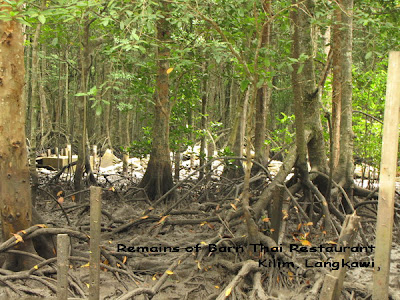

A website claimed that this restaurant was constructed without having a single tree chopped down. Well... I doubt so.

The owner left in a hurry that there were some stuffs left behind in the mangroves. All of these were there for a few months now.

This is one of those things left behind. At an angle, this thing can be clearly identified. Anyone want to guess what "species" is that? Let me give you a hint, is a bowl where we put our bum on it!
4. Next, let's take a boat ride towards the fish farm from Kilim Jetty.


This is one of the latest display which was put up less than six months ago. WHAT IS THIS?? Obstacle course?
5. Next to the "obstacle course", you will see a tributary adjoining Kilim River. According to the local, that is known as Sungai Garam. Do you see the section of mangroves has been cleared?
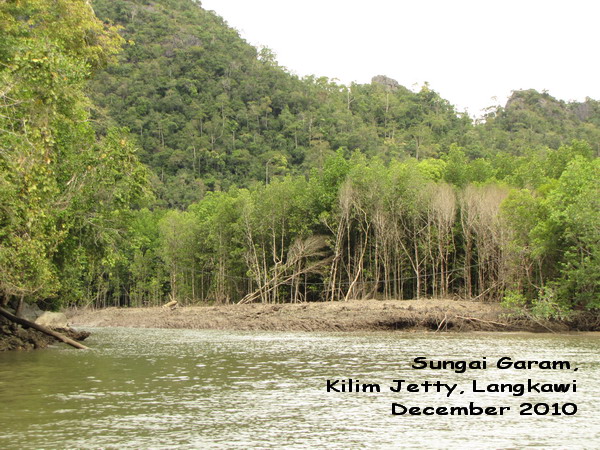
It is such a visible deforestation of the mangroves. Why our authorities claimed that Kilim mangroves are untouched?

According to the locals, that area was cleared to build a small jetty for fishing boats to dock their boats. That area was cleared for almost a year and nothing happens until now. So, all those trees died in vain... sad...
That's all for the Kilim Jetty area. There are more and I will keep them to myself for now. I seriously do not understand how the stakeholders, tour companies and users of Kilim Jetty can withstand all these eyesores that had been there for all these years. No wonder they say Malaysians are very patient lots!
Overall, I must salute En Megat, Tourism Manager of LADA for his bold statement to support conservation efforts in Langkawi. I hope that En Megat will get the fullest support from other government agencies otherwise he will be the soloist in LADA's conservation work. It is a tough job indeed and conservation work cannot rely on a single person. Good luck to En Megat and his team.
==============================================
==============================================
Protecting Langkawi’s splendour
By CHRISTINA CHIN, TheStar
COME March, the Langkawi Country Code, a guideline for sustainable eco-tourism for Langkawi, will be available for all local authorities, tourism operators and stakeholders.
Malaysian Nature Society (MNS) Langkawi branch chairman Eric R. Sinnaya said the code hoped to prevent natural attractions from being ruined by tourism so that everyone could enjoy long-term benefits.
“Tourism can really improve the locals’ standard of living but we must not kill the goose that lays the golden egg,” he said.
“We can have the greenest is- lands in the world if everyone works together.
“Two decades ago, 95% of the Langkawi islands was green — now we are down to about 60%,” he said.
He said although NGOs could prepare a guideline of best practices, the state and local authorities’ support was needed to endorse and enforce the code, adding that the ecology of Langkawi was very sensitive and needed protection.
He said the Pulau Payar Marine Park was a good example of how tourism had resulted in garbage pollution and coral damage.
The code addresses the conservation of existing tropical rainforests, mangrove forests, coastal eco-systems, bio-diversity and landscapes; garbage management; reduction of pollution and usage of natural resources and adoption of ethical business models by all parties.
The code was among the out-comes of the ‘Conservation of Bio-diversity in Langkawi through Sustainable Eco-tourism’ project funded by the United Nations Development Programme (UNDP) and implemented by the MNS.
The project, which was initiated in October 2008, ended on Thursday.
Other activities carried out under the project were bird watching, shark spotting, green month campaign, beach cleanups, jellyfish operation at Pantai Cenang and myriad exhibitions, dialogues and seminars on fauna and flora.
The aim was to nurture, educate and empower the community to protect Langkawi’s natural heritage through a pragmatic environmental awareness, training and monitoring programme as sustainable eco-tourism practices would minimise the negative effects of tourism on bio-diversity and natural resources.
Eric said the RM145mil project was very important for Langkawi because there was low conservation awareness among the locals and those who were aware didn’t know how they could help protect the environment while helping the tourism sector grow.
Langkawi Development Authority (Lada) tourism manager Megat Shahrul Azman Abas welcomed the code.
He said that as a tourist development agency under the Ministry of Finance, Lada’s focus was to develop the 99 islands as a premier tourist destination.
“We want to practice green tourism by complying with eco-tourism practices to ensure sustainable development,” he said.
“The Langkawi Country Code is a very good effort by the MNS — it shows that non-governmental organisations (NGOs) are playing their roles well by being pro-active,” he said, adding that Lada would continue working closely with the MNS.
He said Langkawi’s main draw was her natural surroundings and laidback lifestyle.
“Here, visitors feel very safe — they are not harassed by haggling traders.
“Eco-tourism activities like bird-watching and mangrove tours are very popular these days,” he said.
Tourists arrivals from January to October last year was about 1.8mil compared to more than 1.9mil for the same period this year.
Besides Europe which is Langkawi’s traditional tourist market, Middle Eastern and South Asian tourists are also flocking to the islands.
Megat Shahrul Azman also noted an increase in arrivals from Scandinavian countries.
He said Lada would target tourists from Central Asian countries like Kazakhstan and Uzbekistan next year.
Links:
... Read full post ...




 Posts
Posts

