Showing posts with label Langkawi Wildlife. Show all posts

Tuesday, March 5, 2013

My Light Encounter With A Poacher

It was a Saturday. Weekend for all. A picnic time for local folks in the park and as for myself, it was just another day on the forest trail. 

Walking quietly on the trail while listening for any new bird calls, my smell sense was rudely triggered with the smell of cigarette. My alert senses increased and immediately it send out a message, "Intruder"...beep beep beep 

My alert senses was correct. A "sinister" was lurking around the corner of a connecting trail. He was wearing a long sleeve yellow shirt, bearing a company name of "Lafarge". On the note, Lafarge is a cement company on Langkawi which is harvesting the limestone area in Teluk Ewa and now this company is threatening Gua Pinang in Kubang Badak.

Our eyes met. I was neither smiling nor frowning. My expression was expressionless and I thought I was. I continued to stare directly into his eyes. At an angle of my sight, I noticed him holding a parang (machete). And so was I. Should a few steps from him towards me, I am ready for his head with my blunt parang as I thought to myself.

What's next?

I stepped forward instead, closer to him. We didn't speak until I thought he mumbled something. And so I break the ice by asking him in Malay, "Are you chopping down the tree?"
He replied, "Eh...no la". 
"And then, what are you doing?", I asked again.
"Catching birds", he answered. 
He returned a question to me, "What are you doing here?" 
"I am catching those who are catching birds", I said in return. 
"Eh eh", he said.
"What bird are you catching?". I noticed there were calls of Asian Fairy Bluebird around and no bird cages with him but he was holding a very small tied-up sack and plastic bag. I have never seen locals catching Asian Fairy Bluebirds and the variety of birds they would go for would be bulbuls and Oriental Magpie robins.

He replied, "Dunno. My friend is coming soon. Are you alone?"
"Nope. My friends are behind." I lied. 
I continued, "You cannot catch birds here. Is wrong."

And so, I walked away. After less than 100 meters away from him, I picked up my mobile phone and started to call the Perhilitan (Wildlife Department) officers. I called two numbers of the Perhilitan which I usually liaised with. And I was unable to connect to both of them at all. As if their phones were switched off and so I contacted one of their top officers instead.

After informing the situation to this officer, he told me that there is nothing they can do. 

Eh? Why?

The area where I was is under the State government and so most of Langkawi. And Perhilitan is under the Federal government. Which means that the officers are not able to go into the area to chase the poachers out unless these poachers were caught in possession of protected wildlife. 

"If that's the case, there is no protection to our wildlife here then?" I asked.

"Unless the State government placed personnel to monitor the parks and the rainforest. But unfortunately, they have no funds to hire rangers to look after. Because most areas in Langkawi are not under the Federal government, our Perhilitan rangers will not be placed in those areas.", the officer explained.

"If that's the reason, what's the point of having the Perhilitan department on Langkawi then? I mean Perhilitan has done some good jobs in nabbing poachers in Langkawi but if they don't have full authority over what needs to be done to protect the wildlife here, then what's the point?" 

And then he went on about people not putting wildlife protection in the election manifesto and so the politicians of both parties will not bother as an issue to be addressed. 

Sounds like I have heard of this sort of story before and I am so fed up of all this political issues governing the welfare of our wildlife.


... Read full post ...

Friday, September 28, 2012

Spidey Snail

It was on that evening on the road by the edge of a rainforest, I was trying my luck to look for the Asian Paradise Flycatcher (Terpsiphone paradisi) to photograph. Somehow, something caught my attention. It was just a small whitish leaf-like about two centimeters suspending in the air and it was moving a little. Oh well... just a leaf, probably. Or maybe it could be a spider??? Let's check it out.

As I got closer, I was very amazed to see this.

  
Click on for a closer look.

This is not the best shot... but can you see the strand of mucus?

What I was seeing for my first time was this snail climbing downwards by using its own mucus which looks like a thread made by a spider. As I was attempting to take a closer shot of this delicate creature, it somehow landed on my camera lens. And the strand of mucus stopped at about less than 1 meter above the ground. Gee... I think I "did" it again...sorry snail for ruining your journey. Anyway, I gave it a free ride down by placing it on the ground. I hope it is happy on that spot.

Hey JK of SiputKuning Journal, this post is specially for you! Also require your expertise to tell us more about this wonderful snail. Cheers, mate!


... Read full post ...

Tuesday, September 4, 2012

Another Aaarrrrgggghhhh!

A rather late and quiet morning on a secluded road which lies in the heart of the island's lowland rainforest. I know I was a bit late because the surrounding of the forest was so still and silent. It was hot and sunny as well. 

My aim is to catch a glimpse of any migratory flycatchers.

Started to show himself was a cute little Orange-Bellied Flowerpecker (Dicaeum trigonostigma) hovering over the flowers of Senduduk plant (Melastoma malabathricum).


As if the Orange-Bellied Flowerpecker was the appetizer for this hour of birdwatching, the second appetizer dish came in was a flock of Pin-Striped Tit Babblers (Macronus gularis)  babbling away. They were very generous this time to allow me to observe their streaks on their lower throats and breasts.


A few meters ahead, a long black body descended smoothly on some branches of a tree. A handsome Black Giant Squirrel (Ratufa bicolor) was trying hard to hide itself but I spotted it first. A few steps after, a male Crimson Sunbird (Aethopyga siparaja). The late and quiet morning seems to get a bit more exciting.


On the middle of the road, something familiar was walking with its bum swaying left and right. When it stops, the tail goes up and down. A   Forest Wagtail (Dendronanthus indicus)! It has been aeon since I last saw this wagging birdie. It seems to be leading me. And then it joined two other Forest Wagtails ahead. Indeed is a pleasure to be greeted by a Forest Wagtail.

Reaching the dead end and turning around was the Greater Racquet-tailed drongo (Dicrurus paradiseus) waiting for me. Red-Eyed Bulbuls (Pycnonotus brunneus) joined in the fun as well. 

A familiar soft tune came in. Aha! A Tickell's Blue Flycatcher (Cyornis tickelliae) .. I only saw the female. Though my aim was to look for migratory flycatchers but this local one is satisfying too.

To finish off with the dessert...please click below
     
Suddenly, a high pitch whistling call pierced through the rainforest and I definitely recognised that call. I mimic that call and waited. Less than a minute later, I saw something dashed very quickly like the speed of a lightning into a clump of leaves. I waited for any signs of movement. One minute, two minutes and up to five minutes past. Still no signs of any movement. I mimic the call again. Seconds later, he came out and perched on a liana!! Yeahh!

The moment I have been waiting for!

And then I remembered having to decide which camera to take with me before I left home. Darn! Why didn't I take my Canon Powershot SX1IS?  Having no other choices, I have to use my Canon Powershot S100 with only 5x optical zoom to capture this bird. He perched there for a good ten minutes. Just when I thought I have learned my previous lesson of not bringing my camera, here's another Aaarrrrgggghhhh!   psst.. to TC, now I recall your advise and should have listened to my instinct... Aaarrrrgggghhhh!

Here is this elusive bird:

I was attempting to take the picture of this kingfisher through my pair of binoculars but it was so difficult to keep my hands steady. By then I was lying on the middle of the road while attempting to do so. My attention got diverted by some noise and I saw a Brahminy Kite (Haliastur indus) gliding above me. And something dashed very quickly and when I looked at the liana, the Banded Kingfisher has flown away.


A very good ten minutes and I was all alone by myself indulging this moment. Oh! I couldn't ask for more. Although I didn't catch any glimpse of a migratory flycatcher but seeing a Banded Kingfisher certainly made my day!


For that one hour on that stretch of road, I have my nine-course meal for brunch:
1. Orange-Bellied Flowerpecker (Dicaeum trigonostigma)
2. Pin-Striped Tit Babblers (Macronus gularis)
3. Crimson Sunbird (Aethopyga siparaja)
4. Forest Wagtail (Dendronanthus indicus)
5. Greater Racquet-tailed drongo (Dicrurus paradiseus)
6. Red-Eyed Bulbuls (Pycnonotus brunneus)
7. Tickell's Blue Flycatcher (Cyornis tickelliae)
8. Banded Kingfisher (Lacedo pulchella)
9. Brahminy Kite (Haliastur indus)

Heading towards my car, that same call came from within the forest and as if it was saying "See you again" ...

Yes Banded, we shall meet again real soon ... "Burp!"

Reference:
1. A Field Guide to the Birds of South-East Asia by Craig Robson

Link:
About Senduduk plant

... Read full post ...

Monday, June 4, 2012

Porpita Tortilla!

Hahahaha! Just a little humor will not hurt, right? 

The weird marine creature I encountered yesterday afternoon were Porpita Porpita (it sounds like Spanish to me) and the common name for this Cnidaria phylum is Blue Button Jellies. Although it has the 'jellies' word and they are related to jellyfish but they are not a jellyfish at all. However, they do have nematocysts that can cause irritation to skin when touched and their sting is not powerful.

Porpita porpita

According to the links I have read, the habitat and distribution of porpita porpita are in the warm waters of Pacific, Atlantic ocean, Gulf of Mexico, southern part of United States and even in New Zealand. These hydroids live in pelagic waters and they are blown onto shores.

At least I am having some excitement for this weekend for able to discover something new...awesome! I owe my blog readers a huge thank you for their answers to my weird marine creatures. 

Who are they?

JK of SiputKuning.com, Erica Oliver Heibel via Facebook page, Ria of Wildshores of Singapore, and Patrick Low via Facebook. Thank you all for your time!

Links related to Porpita porpita:

... Read full post ...

Saturday, June 2, 2012

My Weirdest Marine Creature

It was this afternoon when we spotted a small bluish object on a sandy beach. To me, it looked like some fibrous material a.k.a rubbish that was washed up by the high tide. Someone said to me that it isn't a piece of rubbish. And yes indeed. When I picked it up, the center of this object felt spongy. It felt like something which was alive much earlier. And when I looked around the beach, there were more of it were scattered all over the beach located on the North West of Langkawi. 


The bluish colour were running out of the object. Like a blue dye coming out when touches the water. Do you notice that on the above picture?

Click below to see close up pictures...

 The object above the center is the other side of this weird creature
 
The weird marine creature next to a set of sand balls made by sand crabs

A close up. This piece is almost the size of RM0.50 coin

Just when all of them were blue and out-of-the blue, I spotted a Yellow one! There was only one yellow we seen on that beach


What are they? They are not sea urchins, for sure. A few guesses came into my mind. Are they some sort of sand dollars or heart urchins? Or possibly they are some sort of echinoderms. Have anyone seen this species? Or could help to identify, please put your comments below. Thank you!

... Read full post ...

Wednesday, May 16, 2012

Sigh...

It was sometime last week and we were heading towards the Gua Kelawar (Bat Cave) in Kilim Geoforest Park located at the eastern part of Langkawi. What it looked like from a distance was a huge white rock floating towards us. As it got closer to our boat, it drifted past us silently. We went silent upon seeing it. We wanted to hear its story but it was silent and somehow, we understood the fate of this "white rock" from the nasty smell we picked up from its surrounding.
 

I guess your guess is just the same as mine. Click on for closed up pictures.
 
 Unidentified turtle species

I am not sure which species this turtle is and please let us know if anyone could identify it.

From the picture, you can see a huge slit across the rear of the carapace. The slit could possibly be caused by a speed boat running over it when it was out in the open sea. It was later drifted by the current into the mangroves.


I have yet to see a turtle swimming in the waters of Langkawi. Each turtle that I encountered here were the ones floating and lifeless. Rest in peace...


... Read full post ...

Saturday, May 12, 2012

Langkawi Got Crocodile ar?

YES!!

Crocodylus porosus

Where did I spot this wild crocodile? Somewhere in the mangroves... and I cannot tell you the exact location. This was my first time seeing a wild crocodile in the mangroves and indeed it was thrilling!  

If tourist guides or operators tell you that there are no crocodiles in Langkawi, they are just kidding.


... Read full post ...

Wednesday, March 14, 2012

RIP My Fellow Primates

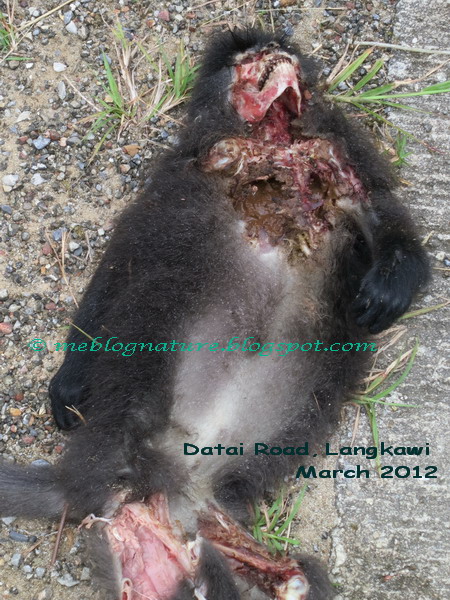
From a distance, I saw a Large-billed Crow (Corvus macrorhynchos japonensis) next to a main road and was peeking on something relatively large and black . I drove past it and I knew it was a carcass for sure. The carcass didn't look like a cat, a dog or even a Long-tailed Macaque (Macaca fascicularis). I was curious and so I made a U-turn.
An adult Dusky Langur (Trachypithecus obscurus) lying next to Datai Road

I saw this...  :( and I photographed the body at different angles for details.


A huge chunk of its thigh has been ripped off or eaten 
The facial skin was ripped off as well revealing the skull
I am not a primate expert but my guess that this could be a female Dusky Langur
Its chest was opened up, rib caged was ripped off and the missing parts were the heart and lungs. Her eyes were missing too.
This doesn't look like an ordinary road kill. I think. The weirdest part was there was no blood nearby its body and no stench at all. There were no maggots suggested that it was killed less than twenty four hours. 

What killed her? Could it be a huge animal that gnawed its selected parts or organs and then it was dragged next to the road? I don't know. And I don't want to know if this is another case of shooting the Dusky Langurs.

While searching for some clues, I stumbled upon something else which was glowing in front of my eyes. I found this...
Looks like belonged to a Long-tailed macaque (Macaca fascicularis)

This may be a skull once belonged to a Long-tailed macaque. I am not surprise to find carcass of this primate. For they love to play along the roadside and even in the middle of road. Long tailed macaque sits at the top five of the road kills in Langkawi.
I then placed the skull facing the main road so it can keep a look out at the cars passing by everyday. And hopefully, a reminder to the rest of Long-tailed macaques to stay out of the road.

As for the dead Dusky Langur, I dragged it further away from the road, laid it sideways and covered it with leaf litters. Not much of a help, I know, for some carrion-eaters will come by and feast on it. 

Rest in peace my fellow primates.

... Read full post ...

Monday, October 3, 2011

Cutie of the Day

A Cutie's wonder...
She is much cuter than a kitty. Wish I can hold her and I can't, for she will scream


Wrapped around by the warm and furry skin of her parent
For now, this little gentle creature is secure and content
She is clinging on with comfort
And she will be independent
To leave the comfort
To survive on her own

As she pops her head out 
Wondering if I am also wondering 
What the future holds for her
Wondering her future will be promising
Wondering the compensation she will be getting
With the removal of her immense precious habitat 
the lowland rainforest
A place in which she calls home.

... Read full post ...

Friday, September 30, 2011

Langkawi's Khazanah

Khazanah in Islam means "Treasure". 

Langkawi's greatest khazanah will be her geological monuments and alongside with her richness of flora and fauna. As for the fauna, I will zoom into the bird life here. The island boasts herself of having more than two hundred species of birds inclusive the migratory ones. I dare say that one of Langkawi's khazanah will be the Great Hornbills (Buceros bicornis). 

Great Hornbills can also be found on Peninsula Malaysia and what is so "khazanah" about them? My argument will be, to get a good and near glimpse of them on Peninsula Malaysia is not as easy as on Langkawi. On Peninsula Malaysia, you probably need to travel a fair bit to see Great Hornbills. And possibly, you will consider yourself lucky if you manage to spot a Great Hornbill flies  into the forest or perch on a tree from a far distance. 

The road built on Gunung Raya has provided an easy access for all to enjoy watching these amazing birds that form monogamous pairs. Easy accessibility to the top of this hill encouraged eco-tourism activities such as bird watching or simply by driving or walking up on the road to admire the wonders of her rainforest. Therefore, the "khazanah" will be $$$ from tourists for coming to Langkawi to see the Great Hornbills.

File picture
Easy access on this hill has invited one of the dangers to Langkawi's khazanah. What will that be?


I took my friend, who is also a tourist, up on Gunung Raya to spot for the Great Hornbills yesterday morning. We spent quite a long time looking for them until we gave up and decided to head down. On our descend from the hill, we were fortunate to spot a pair perched on a huge canopy tree. We were very excited to see them finally!

Then came along a pakcik (our local term for male elder) on his motorbike. I recognised this pakcik because he frequents up Gunung Raya. We chatted for awhile and I took the opportunity to ask him about the poor sightings of Great Hornbills on this hill lately. His shocking story came to us. 

About two weeks ago, he witnessed some locals shot down three male Great Hornbills and slaughtered them. The pakcik called the Perhilitan (Wildlife Department) but there were no one to pick up his call. It was probably lunch time, according to the pakcik. I gave him the mobile numbers of Perhilitan rangers and so he can contact them directly should such incident happens again. 

The poachers must have closely monitored the activities on the hill and have timed their modus operandi perfectly without being caught. The hornbills that were shot down usually ended up in the cooking pot and I am not sure if the meat possessed any medicinal values. 

Poaching of wildlife is one of the greatest threat not only to Langkawi's biodiversity and as well as to the eco-tourism sector. Eco-tourism happens to contribute the highest revenue to Langkawi, largely due to the duty free and UNESCO Geopark status.

My tourist friend was shocked and saddened with such news. 

Reference:

... Read full post ...

Saturday, August 13, 2011

3 In 1

Simply means I saw three of them in one day!

The first one was spotted by a lady on my boat. She has sharp eyes!
A Reticulated Python (Python Reticulatus)

What were the rest?


A lucky spot by me...
Mangrove Pit viper (Trimeresurus purpureomaculatus)

...and the last one before the day ended. I was driving along Datai Road in the dark and my car almost ran over it while it was crossing the road. I stopped my car, ran towards it to check and it slithered into the undergrowth. I quickly ran back to my car to grab my camera and only managed to capture this.

Can you see its tail? I suspect it was a Elapidae, very likely a King Cobra (checked my Snake book shortly after)

People have asked me if there are any snakes in Langkawi. Well, I have seen three different ones in one day. What a lovely snaky day!

... Read full post ...

Saturday, April 30, 2011

My Darlings Of Langkawi

These are the little treats that made my day on a hard day's work...
Giant Squirrel (Ratufa Bicolor)

What was this Giant Squirrel doing?


It was stunned when I shot it with my camera and so it dropped the fruit that it was eating.  Observe the pose of its little hands. Later, it ignored me. I learnt later that it was feeding on the fruits of a notorious poisonous Rengas tree. Do not touch any of the tree's opened fruits or the sap unless you want to be a Puff Daddy.
Fruits of a Rengas Tree

My other darlings... the quiet ones
Colugo female with her baby


... my shy ones, the Dusky Leaf Monkeys (Trachypithecus obscurus)


Taking a break in between feeding time
... last but not least, this is one of my favourite creepy crawly 


Doria's Spiny Spider (Gasteracantha doriae) Simon 1877


Thank you my Darlings... as you are all perfect and it is much better than a mug of beer after a hard day's work!

... Read full post ...

Monday, February 28, 2011

Caught Napping

Have you ever seen a monkey taking an afternoon snooze?

At 4:00pm, this group of Dusky Leaf Monkeys (Trachypithecus obscurus) were relaxing at the front porch of a resort along Jalan Teluk Datai  and then two of them started to fall asleep...

Their zzz postures...


I didn't know that monkeys take afternoon naps like I do. They were so adorable!

... Read full post ...

Saturday, February 26, 2011

Who Is This Peek-A-Boo Reptile?

This beautiful little reptile was trying to evade our cameras while slithering in between the leaf litters and twigs.

Peek-a-boo
What is this species?


I don't know - yet. After having checked my new book, "A Field Guide to the Reptiles of South-East Asia" by Indraneil Das, I can closely match this species to be a keelback snake belonging to the subfamily of Natricidae, however, I am not sure of its genus. Or this snake may be a different family. This field guide is colourfully illustrated and was published in 2010.

Location found: Lubuk Semilang Forest, Langkawi
Forest type: :Lowland Rainforest (less than 200m asl)
Length (TL): Between 70-80cm (estimation only)

Can anyone please help to confirm this species of snake? Thank you.... pppsssssttt...

Dorsal view

Lateral view

... Read full post ...
Sunday, January 10, 2010

An Ambush Predator In the Mangroves of Langkawi

This aggressive mangrove crab is a fierce predator that would snap its claws at anything it thinks it can eat including your feet! (White, 1847)

Forceps Crab (Epixanthus dentatus) picture taken from http://www.madeinnys.com/mangrove/e_dentatus.htm 

According to Dahdouh-Guebas et al., 1999; this Forceps Crab Epixanthus dentatus (White 1847) is an omnivorous crab but preys mostly on crabs and as well as climbing on mangroves roots (Cannicci et al., 1998). 
A forceps crab can grow only up to the carapace size width of 8cm. It can be identified with scattered orange granules on its carapace that normally hides under driftwood, rocks or debris. Like a male fiddler crab, this forceps crab E.dentatus has an abnormal claw. Unlike the male fiddler crab, the forceps crab E.dentatus has one thin claw and the other is a thick crushing claw. See above picture.
The stout right claw has a special tooth used for opening gastropods or crustaceans. While the other thin claw is like a forceps tool (or like tiny chopsticks) extracting the flesh of its prey. Wow! No wonder E.dentatus is called Forceps Crab.

I can't recall having to encounter a live E.dentatus yet but I was fortunate to find its exoskeleton or carapace. This carapace was found on the mudflat at low tide while I was kayaking in the narrow tributaries of Tanjung Rhu mangroves. From the shape of the carapace,  I believe that this E.dentatus must have gone through the molting process. Aha, it had became a soft-shell crab. I hope to see a live one with its claws ready to strike.


Classification: Biota > Animalia (Kingdom) > Arthropoda (Phylum) > Crustacea (Subphylum) > Malacostraca (Class) > Eumalacostraca (Subclass) > Eucarida (Superorder) > Decapoda (Order) > Pleocyemata (Suborder) > Brachyura (Infraorder) > Eubrachyura (Section) > Heterotremata (Subsection) > Eriphioidea (Superfamily) > Oziidae (Family) > Epixanthus (Genus)


This latest classification was taken from : World Register of Marine Species (WoRMS) 


References: 
2.  A Guide to the Mangroves of Singapore II; published by Singapore Science Center.


Acknowledgement:
1. Thank you to A Field Guide to Kenyan Mangroves website for the picture (hope you don't mind)

... Read full post ...

Monday, December 14, 2009

Lucky Bat, perhaps?


A rather early morning bike ride had led me to into the paddy field between Nyior Cabang and Ulu Melaka. I usually ride on the main road but this morning I was curious to check out the off-roads in between the paddy field area. About less than 200 meters, I arrived at the T-junction and I couldn't decide which turning to take. So, I stop to look at the pipit birds on the ground while two Mat Salleh cyclists came from the other direction. I watched them cycled away towards the main road and I decided to go where they were coming from. About 50 meters, I stopped at the funny looking flowering plant (left).
Soon after, I cycled for another 20 meters and saw the netting set up by the locals. I was silently condemning these netting and then I noticed something black was caught on the net. It was still moving and immediately I knew it was a bat.


I always had my rescue knife with me whenever I am at work and not today...grr..grr...grrr.. I only had a set of bicycle toolkit and that is useless for cutting the net. I tried a sharp rock, didn't work. I tried untangling the net very slowly and only managed one side of it. The other side was badly entangled. I decided to rip  the net around it with my bare hands. Finally I did and not feeling guilty at all in leaving a huge hole on the net. 
I saw a barn about 100 meters away and a car parked on the other direction. Instead, I decided to cycle towards the barn to look for something to cut the rest of the entangled net on one side of its wing. While still carrying the bat on one hand, suddenly I remembered I left my bicycle toolkit at the scene and decided to turn back. As I was turning back, I decided to get human help by cycling towards the car.
I noticed two old gentlemen (Pakciks) were crouching on the ground looking at the field. I asked them for a cutter and showed them the bat. Both of them didn't have any cutter and one of the pakcik wearing the white cap (kepah) took out his lighter. Ah, a smoker. Probably this is the only time I appreciate having a smoker around. He gently burn off the strings and looked like he had done this before. The bat was in pain and trying to bite when removing the last bit that wrapped around the bony joint of its wing. I had to hold the other side of its wing and pull its  head so the bat doesn't bite the finger of the helper.  
Finally, it was released! The bat hobbled on the ground for a couple of seconds before it took off into the air. We watched it flew away towards the hill until it was out of sight. Hope that this bat will survive after the struggling and exhaustion. I was so excited of its release that I didn't get to take the full picture of the bat. Aiya! oh well...

This bat is identified as a common fruit bat. The closest species I can identify is it may be  Short-nosed Fruit Bat (Cynopterus spp.). Fruit bats are important dispersers of many pioneer forest trees, thus aiding forest regeneration after disturbance. These fruit bats breed throughout the year in Malaysia, mainly when food is most abundant. 

Glad to know that are lovely local people around. These pakciks are the owners of the paddy field. After a quick chat with them, I thanked the bat saviour, particularly the pakcik on the left. I headed towards the barn and it was a good thing that I didn't go there because there were only cows inside.


Reference: A Photographic Guide to Mammals of South East Asia by Charles M.Francis

... Read full post ...
Related Posts Plugin for WordPress, Blogger...