Showing posts with label Birds. Show all posts

Tuesday, September 4, 2012

Another Aaarrrrgggghhhh!

A rather late and quiet morning on a secluded road which lies in the heart of the island's lowland rainforest. I know I was a bit late because the surrounding of the forest was so still and silent. It was hot and sunny as well. 

My aim is to catch a glimpse of any migratory flycatchers.

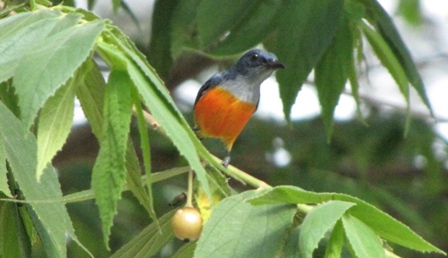
Started to show himself was a cute little Orange-Bellied Flowerpecker (Dicaeum trigonostigma) hovering over the flowers of Senduduk plant (Melastoma malabathricum).


As if the Orange-Bellied Flowerpecker was the appetizer for this hour of birdwatching, the second appetizer dish came in was a flock of Pin-Striped Tit Babblers (Macronus gularis)  babbling away. They were very generous this time to allow me to observe their streaks on their lower throats and breasts.


A few meters ahead, a long black body descended smoothly on some branches of a tree. A handsome Black Giant Squirrel (Ratufa bicolor) was trying hard to hide itself but I spotted it first. A few steps after, a male Crimson Sunbird (Aethopyga siparaja). The late and quiet morning seems to get a bit more exciting.


On the middle of the road, something familiar was walking with its bum swaying left and right. When it stops, the tail goes up and down. A   Forest Wagtail (Dendronanthus indicus)! It has been aeon since I last saw this wagging birdie. It seems to be leading me. And then it joined two other Forest Wagtails ahead. Indeed is a pleasure to be greeted by a Forest Wagtail.

Reaching the dead end and turning around was the Greater Racquet-tailed drongo (Dicrurus paradiseus) waiting for me. Red-Eyed Bulbuls (Pycnonotus brunneus) joined in the fun as well. 

A familiar soft tune came in. Aha! A Tickell's Blue Flycatcher (Cyornis tickelliae) .. I only saw the female. Though my aim was to look for migratory flycatchers but this local one is satisfying too.

To finish off with the dessert...please click below
     
Suddenly, a high pitch whistling call pierced through the rainforest and I definitely recognised that call. I mimic that call and waited. Less than a minute later, I saw something dashed very quickly like the speed of a lightning into a clump of leaves. I waited for any signs of movement. One minute, two minutes and up to five minutes past. Still no signs of any movement. I mimic the call again. Seconds later, he came out and perched on a liana!! Yeahh!

The moment I have been waiting for!

And then I remembered having to decide which camera to take with me before I left home. Darn! Why didn't I take my Canon Powershot SX1IS?  Having no other choices, I have to use my Canon Powershot S100 with only 5x optical zoom to capture this bird. He perched there for a good ten minutes. Just when I thought I have learned my previous lesson of not bringing my camera, here's another Aaarrrrgggghhhh!   psst.. to TC, now I recall your advise and should have listened to my instinct... Aaarrrrgggghhhh!

Here is this elusive bird:

I was attempting to take the picture of this kingfisher through my pair of binoculars but it was so difficult to keep my hands steady. By then I was lying on the middle of the road while attempting to do so. My attention got diverted by some noise and I saw a Brahminy Kite (Haliastur indus) gliding above me. And something dashed very quickly and when I looked at the liana, the Banded Kingfisher has flown away.


A very good ten minutes and I was all alone by myself indulging this moment. Oh! I couldn't ask for more. Although I didn't catch any glimpse of a migratory flycatcher but seeing a Banded Kingfisher certainly made my day!


For that one hour on that stretch of road, I have my nine-course meal for brunch:
1. Orange-Bellied Flowerpecker (Dicaeum trigonostigma)
2. Pin-Striped Tit Babblers (Macronus gularis)
3. Crimson Sunbird (Aethopyga siparaja)
4. Forest Wagtail (Dendronanthus indicus)
5. Greater Racquet-tailed drongo (Dicrurus paradiseus)
6. Red-Eyed Bulbuls (Pycnonotus brunneus)
7. Tickell's Blue Flycatcher (Cyornis tickelliae)
8. Banded Kingfisher (Lacedo pulchella)
9. Brahminy Kite (Haliastur indus)

Heading towards my car, that same call came from within the forest and as if it was saying "See you again" ...

Yes Banded, we shall meet again real soon ... "Burp!"

Reference:
1. A Field Guide to the Birds of South-East Asia by Craig Robson

Link:
About Senduduk plant

... Read full post ...

Saturday, October 16, 2010

Love By All Beings

Being a city person in those earlier years of my life, I had never encounter a tree that bears such addictive sweet juicy fruits that look like cherries until I began my worklife on an island known as Tuba in Langkawi. 

My first response to that first taste - hmm... yummm! And so I was introduced to this tree in Malay language call "Pokok Ceri" (Cherry Tree) by my ex-colleague. I had tasted cherries before but those were the ones that I usually took them off the birthday cakes and straight into my mouth when no one is looking. Those birthday cakes cherries look big and very red but their taste are nothing as compared to those "Pokok Ceri".

Who else likes them?


Your may say this to me - "What? Where have you been in your childhood years? These trees are so common that they are found growing in gardens, in front of houses and beside the roads in urban areas." Yes, I was a typical city person and very much oblivious to plants around me in those years.

This is how the entire Jamaica Cherry Tree (Muntingia calabura) looks like. Shrubby, messy and boring. However, this tree is an excellent shade provider. To me, this is a 2-in-1 tree. It acts as an "umbrella", when someone needs a shelter from the hot scorching sun  and a "snack" corner (when it is fruiting).


The petals of the flowers are plain white with yellow stamens.
Immature flower

The comtemporary love partners ...
The Pollinators
A stingless bee visitation

From flower to young fruit...
Immature cherry

to my "competitors"...
                             
 A male Brown-Throated Sunbird (Anthreptes malacensis) sneaking behind the leaves
His "partner", the female Brown-Throated sunbird was also spotted sneaking behind those leaves
This male Brown Throated sunbird poking on a cherry

                      A "punctured" cherry made by the bird and left aside. What a waste!
Male Orange-bellied flowerpecker (Dicaeum trigonostigma) watching

According to Verheij 1991, the Jamaica cherry is indigneous to South-Central America and the Caribbean. It is believe that the Portuguese were the distributors of this fruit, which was probably first carried to Thailand or Vietnam and then subsequently spread to Malaysia.

A foreign fruit tree which is easy to plant, grows quickly and love by the locals here including the birds.

... Read full post ...

Wednesday, September 15, 2010

Feathered Migrants

Yes! They have arrived and it is the time of the year again, at least for Langkawi. 

Depending on the species, some of them came all the way from Europe, Japan, the Himalayas, Taiwan West and North China.The island maybe a stop over or they can stay on until the end of the season.

Take out your binoculars, clean those fingerprints off the lens, dust off your tucked away guidebook, get a new fine drawing pen and put on your hiking shoes. For the feathered migrants have arrived.

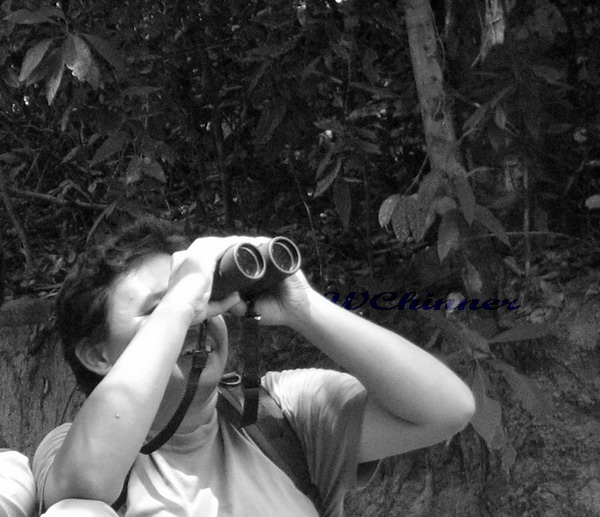
Aida getting excited
Who are the early ones?

Common Sandpiper (Actitis hypoleucos)
Common sandpiper was spotted exactly a month ago on the mudflats and mangroves of Tanjung Rhu, Langkawi. Through my naked eyes, I have also seen lots of Plovers (Charadrius genus), about 12-15 of them.

While in the garden and at the edge of the forest, my cute little Brown Shrike has been spotted too.

Brown Shrike (Lanius cristatus)

Are there any other migratory birds spotted besides these three birds in August and September this year? 

Did anyone spot these three birds earlier than the month of August?  

Common sandpipers were spotted exactly the same time last year.  And I am not too sure about the Plovers and Brown Shrikes. If there is anyone out there doing such observation, it will be great to share. 

Langkawi is now experiencing a dry rainy season this year. I feel like Langkawi has entered the dry season  again and it is the rainy season with the lowest rainfall as compared to those six years ago. While  the visitors here felt they were lucky to have such hot sunny weather, it is a worrying factor for the locals in the agriculture sector. If this year's rainfall is very low, will this affect the natural water supply to the agriculture like the rice field?

It will be interesting to know how our climate change can also affect the migration of birds.

... Read full post ...

Sunday, June 27, 2010

Waves + Surfs = Southwest Monsoon

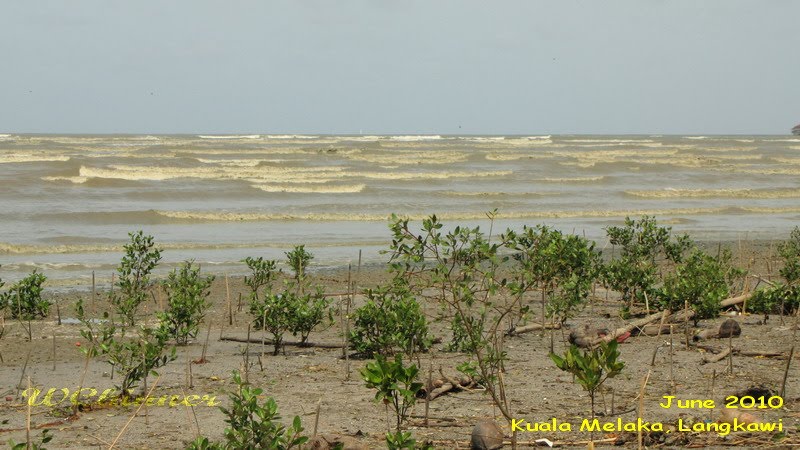
7th June 2010  - our 8th planting on Kuala Melaka site. We selected this date in conjunction with  the World Environment Day which was on 5th June 2010. On this day, I got the opportunity to witness the large surfs coming into the shore. I had only heard about such surfs from the locals and yet to see the real thing because on those days that I came, the surfs were not as big as on this day.
Picture contributed by Mandy

This morning I was checking the tide level for our 9th planting via  our Malaysian Meteorological Department official portal when I stumbled upon their list of earthquakes.  A little bit shocking after looking at the statistics.

From the website of our  Malaysian Meteorological Department, just for the month of June 2010 itself, there were seven earthquakes occurred between 850-1066km Northwest of Langkawi  in the areas of Nicobar Islands and Andaman Islands regions. Only one earthquake  occurred in the Northern Sumatera, 497km Southwest of Langkawi.


After running through the list of earthquakes from January-June 2010, the month of June 2010 has the highest frequency of occurrences and ...pssst.... the distance is getting closer. From the distance of about 2000km to about 1000km or less away from Langkawi.

Staring at the surfs, I had mixed feelings of admiration and fear. Huge mighty surfs are indeed a beautiful sight and yet scary. I couldn't imagine how the surfs and swells look like when the tsunami hit this area on the Boxing day of 2004. I recall being a volunteer helping to clean up the mess in Kuala Teriang school area. And then my mind started to wonder. What if another tsunami comes, will this mudflat have sufficient mangroves to create a strong protection belt? Will these mangroves have the chance to reach its maturity stage before the next tsunami comes?
Bamboo sticks bent by the hitting force of the surfs and debris 
I have to tell myself to stop wondering. That will not help. Let's get back to work. And also on this day, I had a new planter with me...

Mandy in her own world

Meet Mandy, the blog owner of  Not Just Odonata. If you want to know about odonata (dragonflies and damselflies) in Langkawi, go check out her blog.

On this site, I was looking at the increasing amount of trash trapped by those bamboo sticks. 

Drifted coconuts landed on the mudflat were everywhere. They looked like bowling balls about to hit the targets. The targets were the mangroves seedlings. 


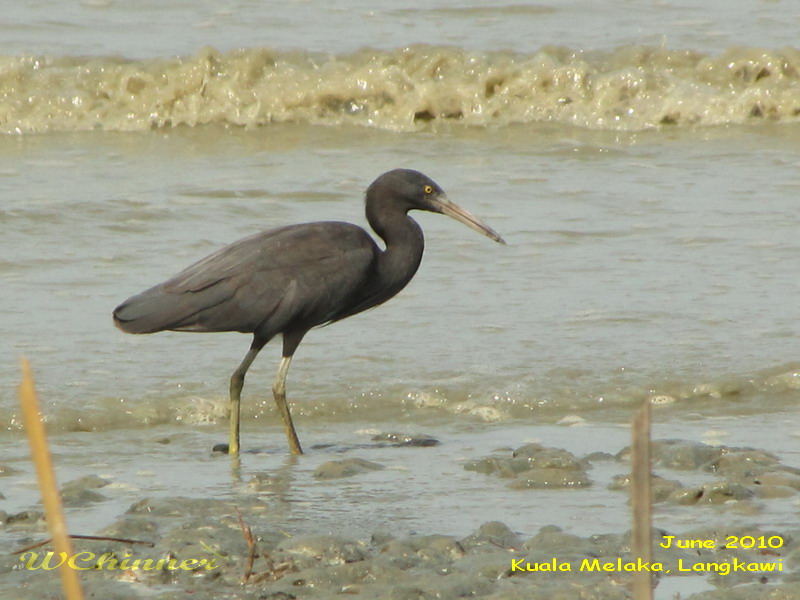
The tide was going out and level at the time of our arrival on this day was about 1.90meter. It was a nice windy sunny morning. A couple of White Bellied Sea Eagles were flying low and skiing with the wind.  Some waders flew in to feed. The frequent visitor,  Little Heron (Butorides striatus) and another not so frequent visitor, Pacific Reef Egret (Egretta sacra) dark morph were spotted at the edge of the mudflat.


And of course, the fiddler crabs (Uca spp.) were present. 

Mandy started to mumble about a fish and I was searching everywhere on the ground for that something she was pointing at. Shortly, my nose caught the stench. Thankfully, the stench was not as awful as the unidentified  suspected cetacean carcass found on Pebble Beach. The carcass Mandy was pointing turned out to be a porcupine fish. 

With just the two of us, we managed to plant about 60-70 seedlings.

Mandy collected some seedlings while she was kayaking in Kilim. Thanks, Mandy for your help.

All done for the day in less than 2 hours and it was time for a drink of Sirap Selasih ("tadpoles eggs-like" in icy cold red blood syrup) at Warung Pais while enjoying the surrounding wildlife.
Pacific Reef Egret aiming for a fish

A Blue Spotted Mudskipper (Boleophthalmus boddarti) leaping in joy or could be trying to attract a female 

And then it landed...

View of the estuary of Kuala Melaka from Warung Pais

... Read full post ...

Tuesday, November 24, 2009

Could this be Langkawi's First Sighting??

Indera Suhardy yelled, "What is this bird? I have not seen it before??" All of us directed our binoculars to the movement among the foliage of the tree with fruits that looked like some berries.

Ku Ismadi and I joined Indera to have a glimpse of Mugimaki Flycatcher (Ficedula mugimaki) on the afternoon of 15th November 09. We got off the cars on the slope with the edge of secondary forests and the air was cooling with some breeze. Just within minutes we were lucky to have this flycatcher perched on a branch.
After Indera's exciting scream, we were looking at this unknown bird. The features I saw were the white vent with dark-scaled undertail-coverts, a very distinct white supercillium, yellow tarsus and a dark greyish upper part. Then another one came along except that it had a brownish upper part. We quickly checked the guide book and got confused. Ismadi had to leave us for work, Indera was thinking of a woodpecker family and I thought it was a dove family. Still clueless, we called for another sifu, Jimmy.

Two sifus, Indera and Jimmy cracking their heads trying to figure out the bird id.
The rain came and it was time to leave the area and the mystery unsolved. Besides the unknown bird and Mugimaki Flycatcher, we also recorded: Asian Brown Flycatcher (Muscicapa dauurica); Blue and White Flycatcher first-winter male (Cyanoptila cyanomelana); Asian Fairy Bluebird (Irena puella).


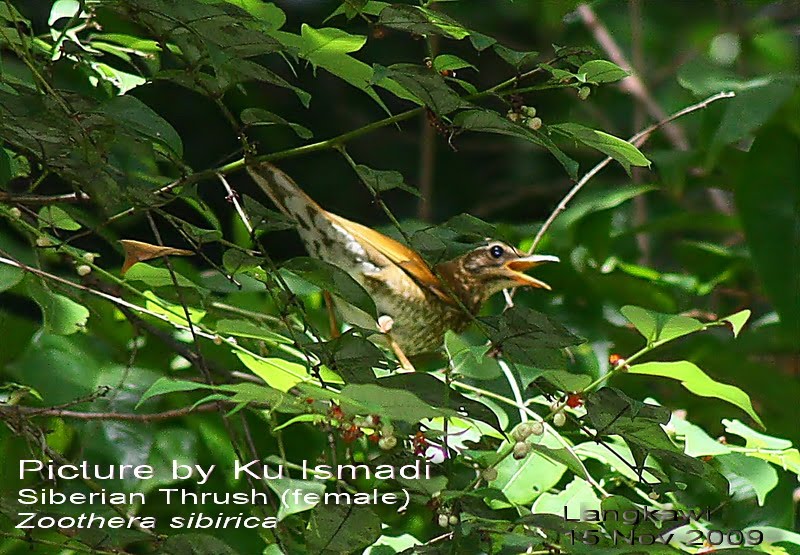
Later that night, I checked through my notes and opened up my guidebook. After a few pages of flipping thru, I was staring at the drawing which fits our observation. I immediately informed Indera and Ismadi that the birds were at least 90% Siberian Thrush (Zoothera sibirica) species.
Indera returned to the same spot on the following day and he excitedly confirmed that the birds were Siberian Thrush. Yeehoo!

Ismadi also returned to the same spot on the 17th Nov to obtain the evidence.


Both of them told me that this species is not in Langkawi's list yet. So, does that mean that this is our first sighting? I have submitted the sighting to Bird i*Witness Malaysia and the Malaysia Nature Society Birds Committee. Let's wait what they have to say then.

Siberian Thrush is omnivorous feeding on insects, worms and berries. The wonderful fact is that this species breeds in the coniferous forest type in Siberia. This thrush would migrate a long journey all the way to Southeastern Asia during winter. And guess what? It is the birds migatory season now!! Go get your bins out!

Thanks Indera for first spotting that birdie and Thanks to Ismadi for the pictures. I got my lifers :)
References:
1. A Field Guide to the Birds of South East Asia by Craig Robson
2. Wikipedia

... Read full post ...
Thursday, October 29, 2009

Kuala Gula Teeming with Birds and Wildlife (via Boat Cruise)

My apologies for being absent for three weeks. The apology is to myself for a start, at least. Besides the normal excuse of being extremely busy with work, I was away for five days at Kuala Gula Mangroves, Perak since Oct 19. This is my second visit to Kuala Gula for this year and a fantastic one.
We didn't get to go round the mangroves on a boat on the previous visit. On this second visit, we managed to hire a fisherman's boat with our chalet owner as our skipper for three hours on the third day. We set off before 8:00am and the tide was going out. The day was hot with blue sky.

Among the mangroves of Peninsula Malaysia, Kuala Gula is one of best spot to find assortment of kingfishers. Especially from October onwards, it is the beginning of the birds migratory season.

Common Kingfisher (Alcedo atthis). Common yet uncommon.

Stock-Billed Kingfisher (Halcyon capensis)


Collared Kingfisher (Todiramphus chloris) Eventhough this can be seen everywhere but it is still appealing. 


Black-Capped Kingfisher (Halcyon pileata)

Kuala Gula also have plenty of White Throated Kingfishers (picture not taken) in the inner land.  They usually can be found along the main road and perched on the cables or poles next to the palm oil plantation.

Coming together with these migatory birds are the egrets and herons.


Little Egret (Egretta garzetta) on the mudlflat

Great Egret (Casmerodius albus) wading.

 
Grey Heron (Andrea cinerea)

Other waders were Common Redshank, Common Sandpiper and Plover family. Then, there was a bird larger than the Great Egrets. We were so fortunate to see this one.


Lesser Adjutant (Leptoptilos javanicus) or known as "Burung Botak" in Malay.

And of course, the top predator bird - the Raptor:


Brahminy Kites (Haliastur indus). Juvenile on the left and Adult on the right.

Brahminy Kites are scavengers. Besides going for their own hunt, they are willing to wait for fishermen to haul up the net for assortments of seafood treats. One example can be seen here. 

Brahminy kites "natural" feeding. Wouldn't Langkawi can be a better place for eco-tourism if the relevant authorities would follow the example of Kuala Gula??

White Bellied Sea Eagles were around but not as frequent as Brahminy Kites and the Crested Serpent Eagle.

Besides the birds, there were other wildlife "treats" as well.


 A Long Tailed Macaque (Macaca fascicularis) hunting for crabs on the mudflat at low tide. Can you spot her baby?

This family of reptile can be seen almost everywhere. This Malayan Water Monitor Lizard (Varanus salvator) here is enjoying its sunbathing moment. It was not bothered at all as we cruised past.


 A Mangrove horseshoe crab (Carcinoscorpius rotundicauda) was caught by a fisherman and later was thrown back into the water. 

 Smooth Otters (Lutrogale perspicillata) swimming shyly away from us.


Eventhough the skipper told us that the population of Giant Mudskippers (Periophthalmodon schlosseri) had reduced in numbers, they still can be seen almost everywhere in Kuala Gula mangroves.

 Unidentified crab spewing out bubbles. I have no clue why is it doing that.

The unexpected treat was the DOLPHINS!! Our boat headed out of the tributary as we wanted to check out the opposite side. Thanks to the low tide on the other side, the skipper was cruising slowly at the river mouth. The river was still calm and it was quiet until I caught a glimpse of it.


 A dolphin's tail flipped over the still calm water.


 What dolphin is this? I need help to ID this dolphin. Its dorsal fin had a pink tip.

The three hour boat ride kept us busy looking thru the binoculars, jotting down notes and taking pictures. The wildlife here is simply awesome. The right timing did help us a lot. Because the tide was going out, this situation allowed feeding activity for the wildlife. On this day, 21st October 2009, the lowest tide was estimated to be slightly below 0.50m.

The abundance of wildlife in Kuala Gula owes itself to the minimum commercialisation for tourism. In return, the mangroves supplement great income to the livelihood of people in Kuala Gula. Most of the industries here are heavily dependent on the products from the mangroves such as shrimps, cockles, crabs and other sea related products.

  Flat short trees yet awesome

... Read full post ...
Related Posts Plugin for WordPress, Blogger...