Showing posts with label Langkawi West Mangroves Planting. Show all posts

Sunday, March 27, 2011

What? Another Planting?

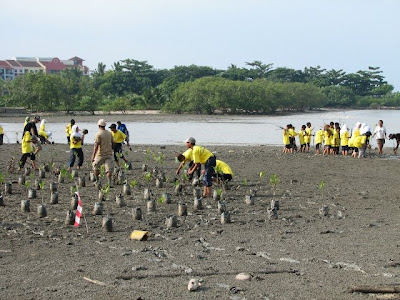
Vanessa called me in the morning on the first week of March 2011; I cannot recall which day was it but it was the early of the week. She sounded so excited over the phone telling me about a group of students have arrived on her backyard and were getting ready into the mudflat. 

While talking to her, I was telling myself, "Oh no... not another planting on the same site.." As I was rushing to get to my work site, I told her to capture a video or some pictures. 

Well... this is her video on youtube...

At the end of the week, I went over to Vanessa's Backyard to check the outcome of the latest planting. 

Saplings barely half alive

After all the planting and fun the group had, it seemed that the project leader had forgotten the most important thing to do - collect all the polybags. Vanessa wasn't happy about all these trash left behind as the tide and current will wash these plastic bags to another location. Also, this kind of project is meant to "be green" and yet the group had forgotten the simplest task; "Clean As You Go".
There were a few of these polybags left at site as most of them were probably washed away before I got there

These were a group of college students who came from the mainland for a holiday-cum-environmental project. My guess would be that this college must have provided the funding for these students to do this planting. Who was the organiser? 

Any mangroves planting especially the Rhizophora genus; will be futile. It is a waste of time and money from the experiences we had. 

Kuala Melaka and Kuala Teriang sites require intervention from the experts so that the generation of mangroves forest can be successful. Meanwhile, let this site be a complete mudflat and allow nature to take its course.


Link:

... Read full post ...

Tuesday, March 15, 2011

All Saplings Gone

In December 2010, I took a researcher from UKM to the mangroves planting site at Kuala Melaka and Kuala Teriang to assess the area. After all my nine times of planting the Rhizophora saplings there,  it is not a surprise that most of the 90% of the seedlings planted by us and other groups were all GONE...
All wiped out!

Let's go back in time. Back then, a planting project sponsored by Digi program in August 2007...


Another group planted at Vanessa's backyard. The group and the date of planting is unknown.


A YouTube Video by Vanessa - Thanks for this!


Another unknown group planted hundreds or if not, almost thousands of seedlings on the coastline of Kuala Melaka and Kuala Teriang in May 2010


And our little planting project-cum-experiment with my group of friends from year 2009 to 2010...


Let's look at how the soil condition of this area can do a 180 degree change!


From very muddy:
Aida in the mud... back in April 2009

Wet, wet,wet in April 2010


...to desert:
Desert in January 2010


And the changes in the population of saplings:
We wanted to test a small plot and so Aida speared a marker into the ground

January 2010: Our marker was still there after a month


Our marker in May 2010

Our marker in June 2010

Our marker was still standing after most of its "friends" (young Rhizophora saplings) were all washed away. Can you see the marker? It has somehow got further into the ground. I didn't push it in, I swear! Accumulation of mud to be blamed?


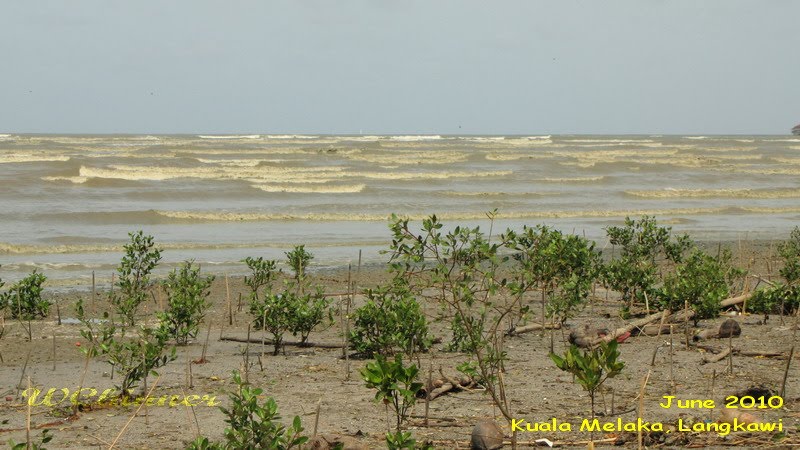
After all of our efforts and amateur strategies, I decided that these spots are impossible to start a healthy mangrove forest due to the wave actions, soil instability and the huge amount of big trash that came in during the South-West monsoon. Unless a wave breaker structure is built at the front, which will be an expensive project; otherwise, any future planting projects would be futile.

Both researchers that I know suggested to plant Avicennia saplings instead of Rhizophora as they are the front liners. I must agree that Avicennia genus of mangroves flora is indeed quite hardy. However, the seeds are difficult to collect. Hmm... another project?

The recent earthquake in Japan has created a strong and devastating tsunami. From the videos I have seen on how the waves destroyed the cities and if the mangrove forest are there, I would imagined that they will be eventually be flatten. (MK, you were right) My deepest condolences to Japan who had lost many lives in the tsunami.


Click here for all the posts on our planting.

... Read full post ...

Wednesday, August 18, 2010

9th and Final

28th June 2010. Long overdue post, I know. This day was my 9th time mangroves planting on Kuala Melaka with me, myself and I. It was a cloudy evening and the storm seemed to be approaching. At the site, I was amazed with condition of the mudflat. 

It was SANDY!!


How the mudflat looked like last year?

Nice clean mirror-like beach... Don't be deceived or you may...
Be stuck at knee deep!

Another amazing event. The mudflat was clean! Let's make a comparison. Here is the picture below taken in first week of June, our 8th planting with Mandy.
These were the rubbish at the edge of the water. Take note at the circle on the picture. That was a beach deck chair. Wonder what happened to that chair? Read on...

And this picture below was taken on this day, 9th planting.
Mudflat turned sandy beach, swept clean! Cleaning away those mangroves seedlings as well.

Yes, a beach swept clean by the strong surfs and waves of course. The strength of the waves pushed that deck chair further in land.
                                  
The deck chair from a resort somewhere has finally found its new home. Together with other trash knocking down most of the mangroves seedlings.
More trash!

When I was about to begin planting, some domestic wildlife came and greeted me. Oh gosh... they came trotting along and stomping on some of the seedlings.
                              
Calves trotting by

I cannot recall exactly how many seedlings I had planted on this day. Probably between 40 to 50 of the Rhizophora Apiculata propagules.

Observing the challenges faced by these young Rhizophora seedlings since our first planting and staggered site visits, I have to submit to reality that this place is incredibly impossible. Perhaps, my friend, Chew was right. Only Avicennia genus or perhaps Sonneratia are the only ones that can survive.

It was also a windy evening and so the storm clouds were blown else where. I only had the drizzles and continued planting till the last one.
Last seedling going in

Good luck to this last seedling

As this will be my final planting on Kuala Melaka and so I left my footprint before leaving the site.
There is always something good that made me stopped and turned around. The fantastic wildlife...
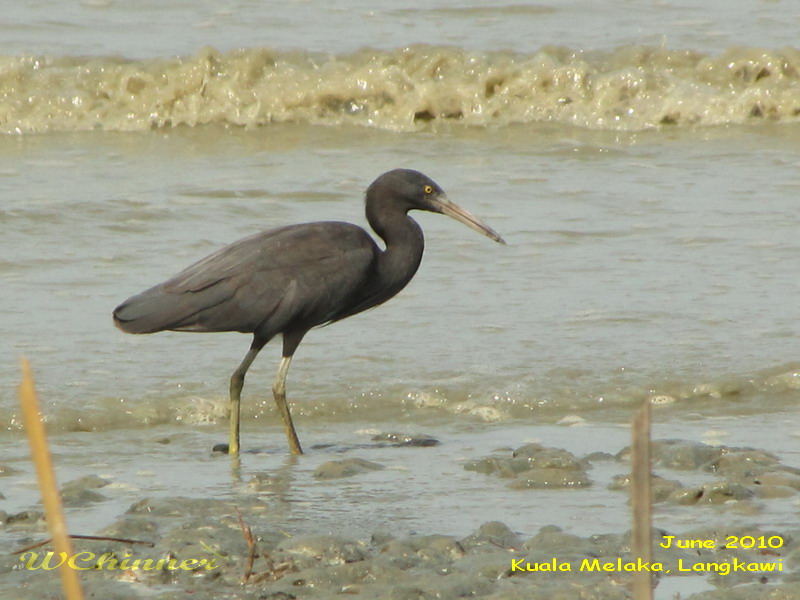
Pacific Reef Egret (Egretta sacra) attempting to catch a mudskipper

This may be my last planting but not my last visit to my favorite "warung" that serves delicious "slurpy" Sirap Selasih, Warung Pais.

... Read full post ...

Sunday, June 27, 2010

Waves + Surfs = Southwest Monsoon

7th June 2010  - our 8th planting on Kuala Melaka site. We selected this date in conjunction with  the World Environment Day which was on 5th June 2010. On this day, I got the opportunity to witness the large surfs coming into the shore. I had only heard about such surfs from the locals and yet to see the real thing because on those days that I came, the surfs were not as big as on this day.
Picture contributed by Mandy

This morning I was checking the tide level for our 9th planting via  our Malaysian Meteorological Department official portal when I stumbled upon their list of earthquakes.  A little bit shocking after looking at the statistics.

From the website of our  Malaysian Meteorological Department, just for the month of June 2010 itself, there were seven earthquakes occurred between 850-1066km Northwest of Langkawi  in the areas of Nicobar Islands and Andaman Islands regions. Only one earthquake  occurred in the Northern Sumatera, 497km Southwest of Langkawi.


After running through the list of earthquakes from January-June 2010, the month of June 2010 has the highest frequency of occurrences and ...pssst.... the distance is getting closer. From the distance of about 2000km to about 1000km or less away from Langkawi.

Staring at the surfs, I had mixed feelings of admiration and fear. Huge mighty surfs are indeed a beautiful sight and yet scary. I couldn't imagine how the surfs and swells look like when the tsunami hit this area on the Boxing day of 2004. I recall being a volunteer helping to clean up the mess in Kuala Teriang school area. And then my mind started to wonder. What if another tsunami comes, will this mudflat have sufficient mangroves to create a strong protection belt? Will these mangroves have the chance to reach its maturity stage before the next tsunami comes?
Bamboo sticks bent by the hitting force of the surfs and debris 
I have to tell myself to stop wondering. That will not help. Let's get back to work. And also on this day, I had a new planter with me...

Mandy in her own world

Meet Mandy, the blog owner of  Not Just Odonata. If you want to know about odonata (dragonflies and damselflies) in Langkawi, go check out her blog.

On this site, I was looking at the increasing amount of trash trapped by those bamboo sticks. 

Drifted coconuts landed on the mudflat were everywhere. They looked like bowling balls about to hit the targets. The targets were the mangroves seedlings. 


The tide was going out and level at the time of our arrival on this day was about 1.90meter. It was a nice windy sunny morning. A couple of White Bellied Sea Eagles were flying low and skiing with the wind.  Some waders flew in to feed. The frequent visitor,  Little Heron (Butorides striatus) and another not so frequent visitor, Pacific Reef Egret (Egretta sacra) dark morph were spotted at the edge of the mudflat.


And of course, the fiddler crabs (Uca spp.) were present. 

Mandy started to mumble about a fish and I was searching everywhere on the ground for that something she was pointing at. Shortly, my nose caught the stench. Thankfully, the stench was not as awful as the unidentified  suspected cetacean carcass found on Pebble Beach. The carcass Mandy was pointing turned out to be a porcupine fish. 

With just the two of us, we managed to plant about 60-70 seedlings.

Mandy collected some seedlings while she was kayaking in Kilim. Thanks, Mandy for your help.

All done for the day in less than 2 hours and it was time for a drink of Sirap Selasih ("tadpoles eggs-like" in icy cold red blood syrup) at Warung Pais while enjoying the surrounding wildlife.
Pacific Reef Egret aiming for a fish

A Blue Spotted Mudskipper (Boleophthalmus boddarti) leaping in joy or could be trying to attract a female 

And then it landed...

View of the estuary of Kuala Melaka from Warung Pais

... Read full post ...
Related Posts Plugin for WordPress, Blogger...