Tuesday, November 24, 2009

Could this be Langkawi's First Sighting??

Indera Suhardy yelled, "What is this bird? I have not seen it before??" All of us directed our binoculars to the movement among the foliage of the tree with fruits that looked like some berries.

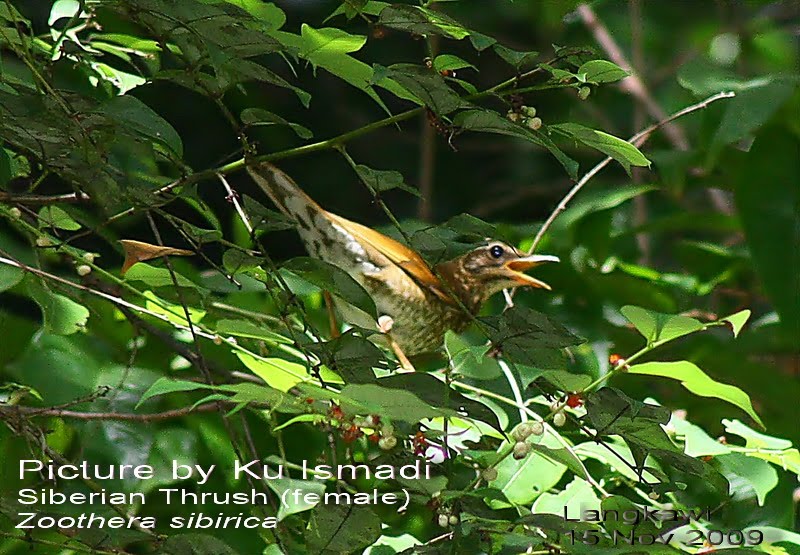
Ku Ismadi and I joined Indera to have a glimpse of Mugimaki Flycatcher (Ficedula mugimaki) on the afternoon of 15th November 09. We got off the cars on the slope with the edge of secondary forests and the air was cooling with some breeze. Just within minutes we were lucky to have this flycatcher perched on a branch.
After Indera's exciting scream, we were looking at this unknown bird. The features I saw were the white vent with dark-scaled undertail-coverts, a very distinct white supercillium, yellow tarsus and a dark greyish upper part. Then another one came along except that it had a brownish upper part. We quickly checked the guide book and got confused. Ismadi had to leave us for work, Indera was thinking of a woodpecker family and I thought it was a dove family. Still clueless, we called for another sifu, Jimmy.

Two sifus, Indera and Jimmy cracking their heads trying to figure out the bird id.
The rain came and it was time to leave the area and the mystery unsolved. Besides the unknown bird and Mugimaki Flycatcher, we also recorded: Asian Brown Flycatcher (Muscicapa dauurica); Blue and White Flycatcher first-winter male (Cyanoptila cyanomelana); Asian Fairy Bluebird (Irena puella).


Later that night, I checked through my notes and opened up my guidebook. After a few pages of flipping thru, I was staring at the drawing which fits our observation. I immediately informed Indera and Ismadi that the birds were at least 90% Siberian Thrush (Zoothera sibirica) species.
Indera returned to the same spot on the following day and he excitedly confirmed that the birds were Siberian Thrush. Yeehoo!

Ismadi also returned to the same spot on the 17th Nov to obtain the evidence.


Both of them told me that this species is not in Langkawi's list yet. So, does that mean that this is our first sighting? I have submitted the sighting to Bird i*Witness Malaysia and the Malaysia Nature Society Birds Committee. Let's wait what they have to say then.

Siberian Thrush is omnivorous feeding on insects, worms and berries. The wonderful fact is that this species breeds in the coniferous forest type in Siberia. This thrush would migrate a long journey all the way to Southeastern Asia during winter. And guess what? It is the birds migatory season now!! Go get your bins out!

Thanks Indera for first spotting that birdie and Thanks to Ismadi for the pictures. I got my lifers :)
References:
1. A Field Guide to the Birds of South East Asia by Craig Robson
2. Wikipedia

... Read full post ...

Wednesday, November 18, 2009

There It Goes Again!

This is my second time catching it red-handed in stealing fish from the fish farm. The owner is not going to be happy. But we were very happy to catch the act of "this drama" which happened in Kilim Mangroves, Langkawi two days ago.

This water dog is known as the Smooth Otter (Lutrogale perspicillata) was spotted snooping on the fish farm.

It checked out the first compartment but no luck. Then it noticed that we were watching. We sensed that it was deciding to flee or try its luck. Also I felt that it had identified our boat was with a bunch of tourists so it decided to continue its act.

It walked over to the next compartment hoping for a luck of meal.
                                     
It walked in a cool manner in search of its next meal. And it found one! It  dived into the compartment, came out with a fish in its mouth and took a dip into the water. All of this action was in less than 30 seconds and left me no time to catch the moment of it capturing the fish. What a cool smooth act! Yes, this smooth otter was faster than my finger tip on the shutter. Bah! I forgot to switch to the continous shooting mode.
Having a face like a dog, smooth otters are considered as one of our mangroves top predators. Not just in the mangroves, these otters were spotted along the coastline of the island. They mainly feed on fishes and are excellent hunters. They are usually shy and can be seen travelling in pairs. In these two years, I noticed a decline of smooth otters population in Tanjung Rhu mangroves. I wonder why?
Have they moved to Kilim in search of food? Being shy creatures, why did they resort to taking fish from the farm instead of hunting? Where do they nest? Have their nesting area been disturbed? Have there been any population count of these otters in Langkawi?

... Read full post ...

Thursday, November 12, 2009

A marine creature close to extinction in the waters of Tanjung Rhu, Langkawi

This is awesome! This was found on the beach of Tanjung Rhu yesterday! I got off the boat and spotted  this starfish in the water.

So, I picked it up to have a closer look.   


It had six long legs and two shorter ones.

Check out the size.

Below picture is showing the underside of the starfish. Notice the tube feet.
                                     
Here's a closer look at the tube feet. Check out the pointed tip. It was a poking feeling when I was holding it.                              
                                     
Not knowing much about starfish or sea stars, I did some search via the world wide web and found that it is very likely to be a Eight-armed Sea Star (Luidia maculata), a family of Luidiidae. This Eight-armed Sea star that I picked up with two shorter legs would very likely be a juvenile or sub-adult.

According to the locals, Tanjung Rhu once had a abundance of corals and sea stars many years ago. Those were the days before the five-star resorts were developed on this beach. A large amount of sand were dredged from the sea and thus reducing the population of these precious sea creatures eventually.

What did I do with this creature in the end? I got back to the boat and instructed my skipper to take me to the middle of the ocean. I said bye and dropped it there. I hope I did the right thing.
Read more about this from: Wikipedia, Eight-armed sea star of Singapore

... Read full post ...

Friday, October 30, 2009

Horror!! Aliens Landed On Payar Island

M and I had nothing much to do on that day and decided to take a ferry down to Payar Island which is supposedly reputed to be the best coral reefs area in the West Peninsula Malaysia. Payar Island is the nearest getaway for cityfolks of Penang, Perak, Perlis and Kedah for snorkelling and diving.

Before we even got off the ferry, we were already put off by the operator's announcement on the timing for the sharks feeding. Instead of watching some sharks scavenging on the scrap food leftover by the tourists' lunch boxes, we decided to take a stroll.

We walked towards the other end of the boardwalk and we were shocked to see a few "alien aircrafts" have landed on the slope of the Payar Island hill.
Semi UFO or Half-golf ball looking chalet. Weird design when it is not even a golf resort.

Thru the "western and eastern wind", we came to know that the whole thing was supposed to be a resort built by by the former Kedah's head of government, Syed Razak bin Syed Zain Barakhbah. The resort was built and it was left abandoned before the operation started. The reasons could be due to strong opposition from other parties that were concerned about the environmental damage. Or possibly Syed Razak had a downfall.

So now that these existing structures are already in placed and what next? Well, since the state is under the new government, YB. Encik Mohammad Radzhi Bin Salleh, the Exco Tourism of Kedah state had approved the operation of 12-room resort. And the winner of the project taker is Raymond Foo of D'Coconut Resort. This information is taken from Langkawi's Marine Park Gets a Resort. You may also read from the comments that Raymond pledged to run the resort in a "green" way. How "green" can be achieved in this highly sensitive area? I'm afraid I'm a non-believer in a green resort. There would be some amount of impact and the only question is how much. What more can the impact do to a highly sensitive area like Payar Island.

Payar Island does not have vast flat areas. Behind the small beaches is the range of hill. That's why the stilted chalets were built on the slopes of the hill.


This is a high potential for sediment run-off during heavy rain and thus increasing sedimentation load on the corals. The increasing sedimentation load on the corals will lead to blocking off sunlight thus reducing the growth of corals.


Human waste will go down into the sewage tank below and eventually cause seepage into the underground. There is no sign of sewage or waste treatment area built. Looking at the geographical landscape of Payar Island, it is almost impossible to build one when there is a lack of flat areas. What if the tank is filled? Nutrients run-off from human activities will encourage algae growth and eventually competes with the corals for sunlight and living space. When corals die, it will be a domino affect, the marine fishes will eventually die.

Here are more hideous looking chalets:

We wonder if any recent an EIA was done for this project? Will our government care enough to do a thorough survey or health check on the corals before allowing the operation of this resort?

For further reports highlighted to the media: Letter to MalaysiaKini, EcoMalaysia.org

Sadly, the jewel of Langkawi is willing to be sacrificed for the sake of making quick monetary return instead of conserving what is left on our west coast and not realising that the rice bowl of the islanders will eventually be broken.

Eventhough it was supposedly a low season on that day, look at the number of people on that beach. I wonder what will be like on high season... eeewwwww...

Other references:
1. Yusri Yusuf's Thesis on Payar Marine Park
2. WWF's Lim lee ching "Lim, L.C., 1998. Carrying Capacity Assessment of Pulau Payar Marine Park, Malaysia - Bay of Bengal Programme.
... Read full post ...

Thursday, October 29, 2009

Odonata or Something Else??

Check out Mandy's latest blog entry on this strange insect.

It looked like an odonata but it was some sort Fly. I have never seen such before. Or maybe I did and simply ignored it, taking it for granted.
... Read full post ...

Kuala Gula Teeming with Birds and Wildlife (via Boat Cruise)

My apologies for being absent for three weeks. The apology is to myself for a start, at least. Besides the normal excuse of being extremely busy with work, I was away for five days at Kuala Gula Mangroves, Perak since Oct 19. This is my second visit to Kuala Gula for this year and a fantastic one.
We didn't get to go round the mangroves on a boat on the previous visit. On this second visit, we managed to hire a fisherman's boat with our chalet owner as our skipper for three hours on the third day. We set off before 8:00am and the tide was going out. The day was hot with blue sky.

Among the mangroves of Peninsula Malaysia, Kuala Gula is one of best spot to find assortment of kingfishers. Especially from October onwards, it is the beginning of the birds migratory season.

Common Kingfisher (Alcedo atthis). Common yet uncommon.

Stock-Billed Kingfisher (Halcyon capensis)


Collared Kingfisher (Todiramphus chloris) Eventhough this can be seen everywhere but it is still appealing. 


Black-Capped Kingfisher (Halcyon pileata)

Kuala Gula also have plenty of White Throated Kingfishers (picture not taken) in the inner land.  They usually can be found along the main road and perched on the cables or poles next to the palm oil plantation.

Coming together with these migatory birds are the egrets and herons.


Little Egret (Egretta garzetta) on the mudlflat

Great Egret (Casmerodius albus) wading.

 
Grey Heron (Andrea cinerea)

Other waders were Common Redshank, Common Sandpiper and Plover family. Then, there was a bird larger than the Great Egrets. We were so fortunate to see this one.


Lesser Adjutant (Leptoptilos javanicus) or known as "Burung Botak" in Malay.

And of course, the top predator bird - the Raptor:


Brahminy Kites (Haliastur indus). Juvenile on the left and Adult on the right.

Brahminy Kites are scavengers. Besides going for their own hunt, they are willing to wait for fishermen to haul up the net for assortments of seafood treats. One example can be seen here. 

Brahminy kites "natural" feeding. Wouldn't Langkawi can be a better place for eco-tourism if the relevant authorities would follow the example of Kuala Gula??

White Bellied Sea Eagles were around but not as frequent as Brahminy Kites and the Crested Serpent Eagle.

Besides the birds, there were other wildlife "treats" as well.


 A Long Tailed Macaque (Macaca fascicularis) hunting for crabs on the mudflat at low tide. Can you spot her baby?

This family of reptile can be seen almost everywhere. This Malayan Water Monitor Lizard (Varanus salvator) here is enjoying its sunbathing moment. It was not bothered at all as we cruised past.


 A Mangrove horseshoe crab (Carcinoscorpius rotundicauda) was caught by a fisherman and later was thrown back into the water. 

 Smooth Otters (Lutrogale perspicillata) swimming shyly away from us.


Eventhough the skipper told us that the population of Giant Mudskippers (Periophthalmodon schlosseri) had reduced in numbers, they still can be seen almost everywhere in Kuala Gula mangroves.

 Unidentified crab spewing out bubbles. I have no clue why is it doing that.

The unexpected treat was the DOLPHINS!! Our boat headed out of the tributary as we wanted to check out the opposite side. Thanks to the low tide on the other side, the skipper was cruising slowly at the river mouth. The river was still calm and it was quiet until I caught a glimpse of it.


 A dolphin's tail flipped over the still calm water.


 What dolphin is this? I need help to ID this dolphin. Its dorsal fin had a pink tip.

The three hour boat ride kept us busy looking thru the binoculars, jotting down notes and taking pictures. The wildlife here is simply awesome. The right timing did help us a lot. Because the tide was going out, this situation allowed feeding activity for the wildlife. On this day, 21st October 2009, the lowest tide was estimated to be slightly below 0.50m.

The abundance of wildlife in Kuala Gula owes itself to the minimum commercialisation for tourism. In return, the mangroves supplement great income to the livelihood of people in Kuala Gula. Most of the industries here are heavily dependent on the products from the mangroves such as shrimps, cockles, crabs and other sea related products.

  Flat short trees yet awesome

... Read full post ...
Related Posts Plugin for WordPress, Blogger...