Showing posts with label Kinabatangan. Show all posts

Wednesday, December 22, 2010

My Sabah On a Shoestring 2: Pitta Lurer And Cave Dwellers

Bart, our guide was tip-toeing on the forest floor, whistling gently while tracking down on this elusive feathered winged creature. We followed along and with our cameras ready. Not long after I remembered that I had left my torchlight at our sleeping den. And so, I had to dash back to our campsite to grab my torchlight. 

On my way back to the position of Bart and Aida, a Crested Serpent Eagle (Spilornis cheela) was up above me spreading its wings to dry. Wow!

That eagle was not what Bart was going after. Suddenly, I saw Bart's eyes went big and was signalling us to come quickly. He caught it!

We couldn't believe that Bart got this Black-Headed Pitta (Pitta ussheri)  to stay on as it was curious with Bart's whistling. We had almost 10 minutes to "drool on" this pretty Pitta until it realised that we were not the same feathered kind. Aida's and my lifer!! In that 10 minutes, we had totally ignored the mosquitoes around us and the high humidity of the forest.
 Some bug that looks like an UFO, hmm... a spaceship bug then??

As we continued on the trail, we found ourselves walking up a short steep slope and then scrambling up on rocky terrain. 

Hundreds of bats greeted us at the entrance of the cave.  The wind welcomed us and gave us a cooling effect on our bodies. The strong smell of guano tickled our nose as we walked on soft carpet of guanos. I was intrigued with the dung beetles (Scarabaeidae) that crawled out each time we lifted up our legs off the guanos. Unfortunately, I couldn't get to photograph them because when those beetles crawled out, they quickly dug themselves into the fresh guanos again.
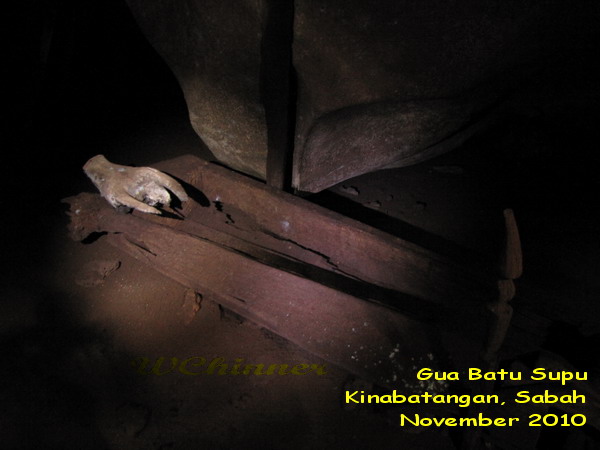
This cave is Gua Batu Supu, according to Bart. Gua Batu Supu is one of sites in Sabah where the dead people were placed in log coffins and left in caves. Based on a writeup by Yunus Sauman on Cave Burials in Sabah, there are at least 13 sites with ancient log coffins in Sabah. The tradition is still being carried on today by some local tribes, including the Dusun Sungai community at Tongod and Ulu Kinabatangan and the Dusun Segama groups at Kampung Tawayari, Ulu Segama. 
 Bart showing the log coffin
 Log coffin but where are the remains??
Some log coffins are known to have craved designs like a buffalo, snake, crocodile, tongue, fish's tail or even a plant. These designs in places such as the Kinabatangan Basin reflect the close links of local folk with their natural surroundings.
Some strange lights?
Sunray puntured through the darkness

Amazing cave! I was reluctant to leave the cave but it was time to move on. We decamped and on board the boat down river back to the jetty in the pouring rain.
Rain clouds ahead of us before it started to pour

From Kampung Mengaris, Kinabatangan, where we waited by the road for our bus  ...


 The pictures above and below is a totem pole completed by venturers of Raleigh International


A species of stick insect picture was managed to be taken just in time before the bus arrived

to the place where the Man of the Forest gathers...

Many thanks to Bart for showing us around. He can be contacted at: badboybartx@yahoo.com, for request of a nature guide in Kinabatangan River.


References:
1. Cave Burials in Sabah by Yunus Sauman

... Read full post ...

Wednesday, November 24, 2010

My Sabah On a Shoestring: Wild Beings of Riverside

Kinabatangan River - 560 kilometers, Malaysia's second longest river and Sabah's longest.

Most nature lovers would know that this river provides an important source of livelihood for its native people known as Orang Sungei (literally means people of the river) and as well as to its vast diversity of wildlife. At the lower Kinabatangan River, which is known as Sukau where tourists would flock to see wild Probosis Monkeys (Nasalis larvatus), Orang Utans (Pongo pygmaeus), Bornean Pygmy Elephants (Elephas maximus borneensis), estuarine crocodiles (Crocodylus porosus) and many more. 

The award winner of Asia's leading Green Hotel, Sukau Eco Lodge would be a perfect choice for most nature lovers to spend their holiday at Sukau. The temptation was there but their exorbitant package rates drew us away. And so, Aida and I decided to experience Kinabatangan River on a shoestring.


The bus ride from Inanam to the Kinabatangan bridge took us more than six hours of travelling before arriving Kampung Mengaris, Batu Puteh at 3am. Bart, our guide, greeted us on the pitch dark road of the village decorated by millions of stars up in the black sky. Some people did say that Langkawi is the best place for stars gazing but this place has beaten Langkawi.


Bart, a localised green badge guide, is also a friend of Aida's via projects that both of them worked together. So, I was fortunate. As it was still the wee hours of the morning, we had to salvage as much sleep as possible before setting out on our exploration. And so we slept on the jetty under the Kinabatangan bridge.


The glimpse of sun light at 5:45am woke me up and this was what I saw.


The planning stage only began after our breakfast at a local shop and the overall itinerary was dependent on our budget. After all the "brain-storming", we decided to take the river cruise after lunch. Meanwhile, Bart took us to Perpaduan Village, about 15 minutes drive away to an observation tower surrounded by oil palm plantation.


As I was looking from the top of the tower, I was pondering on the battle between our lowland rainforest and the palm oil plantation. Who would win? Will both of them live in harmony without creating extinction to the wildlife?


Bart spotted Red Leaf-Monkeys (Presbytis rubicunda) on the salt-lick trail. These primates were so shy and they jumped away quickly before I could reached out for my camera. My primate lifer!


Other flora and fauna along the trail:
Some sort of fungi. Anyone can help to id please?


A damselfly! Which I thought it was one earlier. Many thanks to Mandy for correcting me. It is an Antlion (Myrmeleontidae family)


River cruise at 2:30pm when Bart took us down river for 10 minutes. Could it be his instinct or he may had made appointments with these beings? We spotted them within that 10 minutes!
Another primate lifer! This one showed her teeth at us. I was surprised that Probosis monkeys would do that 
A wild estuarine crocodile (Crocodylus porosus). Alas, not those in the crocodile farm


We headed upriver after that which was our initial plan. The plan was to camp in the forest and it was a 45-minute ride upriver by boat. Why that campsite? Because of the stories about a cave nearby that made us drooled.


The 45-minute ride became almost a two-hour journey. We saw two groups of Probosis monkeys, Black Hornbills (Anthracoceros malayanus), Darter (Anhinga melanogaster) , Green Imperial Pigeon (Ducula aenea)  and lots of Blue-Throated beeaters (Merops viridis). 
Green Imperial Pigeon (Ducula aenea)


Aida with her brand new Canon G12 camera
Wonder why they call the village Kampung Mengaris. Mengaris is referring to those Tualang trees (Koompassia excelsa) that are found abundance along the river.


Lots of fig trees were fruiting along the river that had attracted the pigeons, hornbills, long-tailed macaques and many more


We arrived the campsite at 5pm and we were set to embrace the mosquitoes. There was sufficient time for us to set up our "sleeping den" before the sun starts to set after 6pm.
The kitchen area of the campsite. This nice wooden hut is not for us.
View of the river peeping from our "sleeping den"


Our enthusiastic guide, Bart arranged for a night walk behind our campsite. This was our wishlist to spot: Slow Loris, Flying Lemur and Giant Squirrel... but well, at least we did try to wish. With our pace, we took two hours instead of the intended walk of one hour.
 These sort of fungi illuminates in the dark after shining your torchlight on them
Bart spotted these scorpions mating. According to Bart, this species of scorpion will spray a mist of liquid that smells like vinegar in self-defense or escaping from a predator
 An appreciation to JK of SiputKuning for his help to identify this snail which is endemic to the Borneo lowland forest. Thanks JK!


It was a long day and I was looking forward to crawl into our "sleeping den".
Hey, Aida... I did control that night. You were saved from being "gassed" 


I have always love hammocks. Being my first time climbing onto the top of a double-storey hammock, thanks to Aida's idea, it was a bit tricky. Not long after we snuggled into the warm comfortable fabric of our hammocks, the mosquitoes came and joined us. On the next morning, I noticed a few droppings on the flysheet and we realised that Long-tailed macaques were also sleeping above us on the trees.


What's our itinerary on the next day? Next post ba...

... Read full post ...
Related Posts Plugin for WordPress, Blogger...